
A Nation United—and Divided—by Our Homes’ Architectural Styles

By Susanne Dwyer

image006

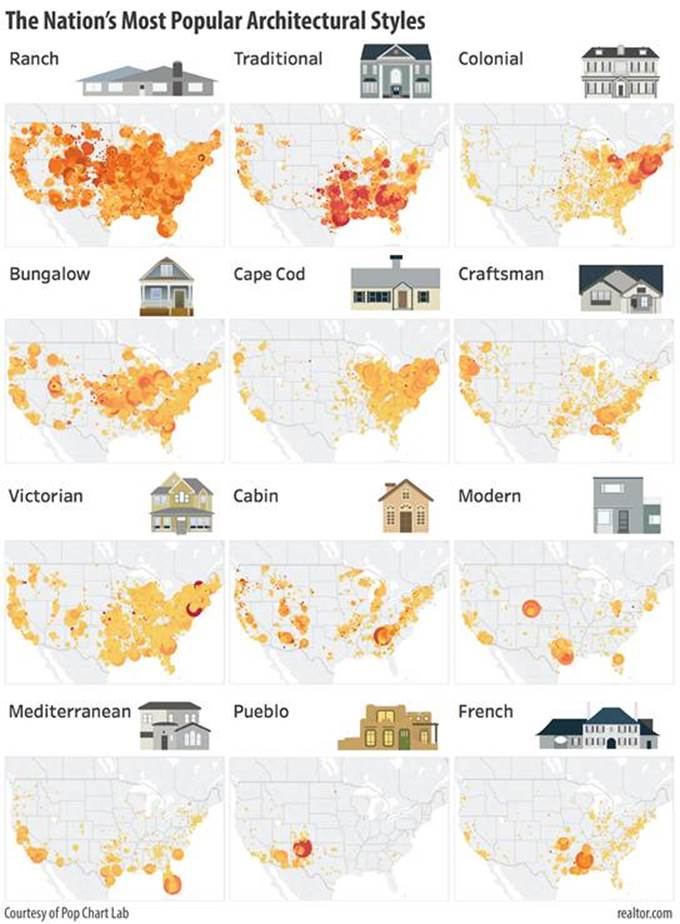
It’s worth emphasizing now more than ever: Diversity is what the United States of America is all about. The country, of course, was cobbled together on this very idea—diversity of geography, beliefs, people. And even the homes they live in! We’ve got architectural styles rooted in the history of our nation before it was a nation (Colonial, Pueblo), a variety of imports (Spanish, French, Mediterranean) and lots of utterly contemporary styles.

So what is an American home, really? It might be easier to come up with a definitive answer to the question: What’s the ultimate American TV show or ’80s rock band? (For the record, “Breaking Bad,” and the Replacements, respectively). But just as with pop culture or food, there are some tastes that unite us and others that are regional preferences.

We thought it was the ideal time to dive deep into our own data to find the architectural home styles that best define our nation. We looked into realtor.com®’s listing descriptions to find out which types of homes are mentioned the most, where they are most popular, and whether their prices are going up or down as they fade in and out of vogue.

Here’s what we found: some seemingly ironclad regional preferences. Some changes. A few surprises. And one clear winner for the title of the American home.

Most regional architectural styles in the United States have their roots both in history and in the environment: They grew out of the types of building materials, such as stone, wood, or clay (for bricks), that were readily available during the early period of development, and the climates that these homes were constructed to withstand, says architect Mark Hogan of OpenScope Studio in San Francisco. They were also often reminiscent of popular styles in the regions where the builders and buyers hailed from—including European influences for Spanish, French, and Tuscan-style homes.

For those reasons, “when people were first settling the West Coast … it ended up looking very different than what was being built on the East Coast at the same time,” Hogan says. “They were very limited to what [materials] they could find nearby.”

And yet there is one style that has managed to conquer most of the nation. Drumroll, please. The most popular home style in 29 of the 50 states is….

The ranch home.

To housing experts, this is no surprise. Ranch houses can be built quickly and inexpensively and can be customized easily to suit the whims of buyers. Although the low-slung style is inspired by the Old West, it spread across the country with the rise of automobile culture in the 1960s. Able to accommodate one or two cars, the sprawling homes quickly populated the new suburbs.

“The ranch style signals a lifestyle change of that age. Front porches went away, and people are more into backyard living and protecting privacy,” says Tim Cannan, president of PreservationDirectory.com.

The second most popular architectural style is the “traditional,” a somewhat vague classification encompassing a variety of classic designs, defined by simple rooflines and symmetrical windows, …read more

From:: Real Estate News

LPL Financial shares jump on report company is exploring a possible sale

Shares of LPL Financial Holdings Inc. [S: LPLA] surged in afternoon trading on Tuesday, with the stock jumping 8.6% to $33.47, the highest price for the stock since January. The move represented the biggest one-day pop for the shares since February.
The move followed a unconfirmed report from Reuters that the Boston-based financial services company was working with Goldman Sachs [S: GS] to explore a possible sale. The stock was briefly halted in afternoon trading, but trading accelerated after it reopened. More than 2.2 million shares traded, several times the stock’s 30-day average of roughly 511,000.

Market Pulse Stories are Rapid-fire, short news bursts on stocks and markets as they move. Visit MarketWatch.com for more information on this news.

…read more

From:: Stock Market News

Oil futures fall, but hold above $50 a barrel

Oil futures fell on Tuesday, but held their ground above the $50-a-barrel level. The International Energy Agency reported that crude output from the Organization of the Petroleum Exporting Countries rose in September, even as the group continues to discuss a plan to cut back on production. November West Texas Intermediate crude fell 56 cents, or 1.1%, to settle at $50.79 a barrel on the New York Mercantile Exchange. Prices rose 3.1% on Monday, buoyed by news that Russia planned to back OPEC’s proposal to reduce output.

Market Pulse Stories are Rapid-fire, short news bursts on stocks and markets as they move. Visit MarketWatch.com for more information on this news.

…read more

From:: Stock Market News

Over $800 Million in Fannie Mortgages for Sale

More than $800 million in previously delinquent home loans owned by the Federal National Mortgage Association that are now performing are for sale.

In all, a pool of 3,600 residential loans with an aggregate principal balance of $806 million is being auctioned off by the Washington-based organization.

The reperforming mortgages have been delinquent in the past but have since become current. In some cases, loans were brought current with modifications.


…read more

From:: Financing

“A good day for democracy” or a “reckless decision”: Mortgage industry reacts to watershed PHH-CFPB ruling

While it’s too early to know the full impact of the United States Court of Appeals for the District of Columbia Circuit’s decision to rule the structure of the Consumer Financial Protection Bureau unconstitutional and vacate a $103 million fine against mortgage lender PHH, opinions from all sides are pouring in on just what the court’s decision could mean for housing and for the financial services industry as a whole. …read more

From:: Real Estate Wire

Gold futures mark 7th loss in 8 sessions

Gold futures fell Tuesday to mark their seventh loss in the last eight sessions, as the dollar traded solidly higher in the wake of Brexit-induced losses for the British pound. “This correction is not driven by fundamentals, but due to dollar strength mixed with the triggering of stop losses,” said Nico Pantelis, head of research at Secular Investor. “The $1,260 level looks like a good consolidation area for now but in the short run, we could see gold make another attempt to drop towards $1,200,” he said. December gold fell $4.50, or 0.4%, to settle at $1,255.90 an ounce.

Market Pulse Stories are Rapid-fire, short news bursts on stocks and markets as they move. Visit MarketWatch.com for more information on this news.

…read more

From:: Stock Market News

Mortgage Industry Wins Huge Legal Battle With CFPB

A federal appeals court has ruled in favor of PHH Corp. in an action challenging a Consumer Financial Protection Bureau order and its structure.

In June 2015, CFPB Director Richard Cordray issued an order requiring PHH to pay $109 million over kickbacks received for reinsurance.

The hundreds of millions of dollars received by PHH were in violation of the Real Estate Settlement Procedures Act, according to the regulator.


…read more

From:: Financing

Repossessions Rise, Mortgage Delinquency Down

While serious delinquency on home loans retreated to a nearly nine-year low, the number of homes repossessed rose for the third month in a row.

Loans at least 90 days past due accounted for 2.8 percent of all mortgages outstanding as of Aug. 31 — the lowest rate since September 2007.

The rate of serious mortgage delinquency was previously reported at 2.9 percent as of one month prior and 3.4 percent as of one year previous.


…read more

From:: Financing