Stanley Black & Decker is buying Newell’s tools business for about $2 billion in cash

Stanley Black & Decker announced Wednesday a deal to buy Newell Brands Inc.’s tools business for $1.95 billion in cash. Stanley said it expects the acquisition, which is expected to close in first half of 2017, to add an adjusted 15 cents a share to earnings in the first year, increasing to about 50 cents a share by year three. The deal is expected to result in cost synergies of $80 million to $90 million by the third year. The brands included in Newell’s tools business includes Irwin and Lenox. “Newell Tools is an important step in our quest to further strengthen our presence in the global tools industry,” said Chief Executive James Loree. Stanley’s stock, which was still inactive in premarket trade, has climbed 10% year to date, while Newell’s shares have surged 14% and the S&P 500 has gained 4.5%.

Market Pulse Stories are Rapid-fire, short news bursts on stocks and markets as they move. Visit MarketWatch.com for more information on this news.

…read more

From:: Stock Market News

Cubs advance in playoffs as Giants’ bullpen collapses

The Chicago Cubs kept alive their dream of their first World Series appearance since 1945, coming back in the ninth inning to defeat the San Francisco Giants, 6-5, on Tuesday night to win the National League Division Series. The Giants appeared on the brink of tying the series at two games apiece and sending the series back to Chicago, but their bullpen collapsed in the ninth inning, with five relievers giving up four runs to the Cubs. It was the 32nd blown save of the year for the Giants, the most in the league. The Cubs, who have not won a World Series since 1908, finished the year with the league’s best record, and will next face the winner of Thursday’s game between the Washington Nationals and Los Angeles Dodgers in the National League Championship Series.

Market Pulse Stories are Rapid-fire, short news bursts on stocks and markets as they move. Visit MarketWatch.com for more information on this news.

…read more

From:: Stock Market News

Mortgage-Related Conventions Happening

Although one mortgage conference was canceled due to the recent hurricane, another is set to start next week. Several events are targeting banking executives.

Harrah’s Convention Center in Atlantic City, New Jersey, is the location of the 8th Annual Northeast Conference of Mortgage Brokers and Professionals.

The event, which takes place from Oct. 17 through Oct. 20, costs between $165 and $330 depending on association membership status and sessions attended.


…read more

From:: Financing

Mortgage Business Expands at Lake Michigan CU

Home-lending activity was up by a fifth at Lake Michigan Credit Union’s, as the size of its servicing portfolio rose, and its mortgage payroll grew larger.

There were 55,030 residential loans being serviced for $8.513 billion as of the end of the third-quarter 2016 at the Grand Rapids, Michigan-based firm.

The numbers, as well as other operational metrics, were revealed as part of the Mortgage Daily Third Quarter 2016 Mortgage Origination Survey.


…read more

From:: Financing

Wells Fargo fallout: New York places restrictions on incentives for bank employees

At the core of the fake account scandal surrounding Wells Fargo right now is the fact that more than 5,000 of the bank’s former employees opened more than 2 million fake accounts to get sales bonuses. As the Wells Fargo situation works it way through various political and judicial machinations, the state of New York is taking measures to ensure that similar behavior, which led to a $185 million fine for Wells Fargo, doesn’t happen again. …read more

From:: Real Estate Wire

CFPB Structure ‘Unconstitutional,’ Rules Appeals Court

By Beth McGuire

Today, a federal appeals court ruled that the single-director structure of the Consumer Financial Protection Bureau (CPFB) represents an “unconstitutional concentration” of executive power. The U.S. Court of Appeals for the District of Columbia found problem with the inability for other government sectors to admonish—or even review—the Bureau’s actions, with too much power placed at the hands of the CFPB’s director. This long-awaited decision will make waves in the housing industry, although there is still much work to be done.

The ruling came as part of a long-standing legal battle between the CFPB and nonbank mortgage lender PHH, which sued CFPB Director Richard Cordray, arguing that the CFPB’s single-director structure and funding model were unconstitutional. However in the ruling, the court decided against shutting down the CFPB, instead ruling the agency should be restructured so that the director could be removed by the president at will.

RESPRO President and Executive Director Ken Trepeta said the present ruling “is a major victory for PHH, industry, and those of us, such as RESPRO® and its members, who have worked diligently to ensure that RESPA is both respected and accurately interpreted.”

In Tuesday’s 110-page ruling, the court of appeals noted that executive power can be granted to lower administrative agencies, but that it must be limited to the reach of that power.

“Today’s decision offers much-needed clarity on the legality of marketing service agreements, and makes clear that MSAs are compliant with RESPA provided that payment for goods and services actually furnished or performed are made at fair market,” said NAR President Tom Salomone in a statement. “We’re hopeful this will address any uncertainty moving forward and offer a clear road ahead for any of our members who have entered into MSAs with settlement service providers. We will continue to monitor this case and the further appeals that are likely, and continue to communicate to REALTORS® on what this means for them and their business.”

“The court ruled that the structure of the CFPB was unconstitutional, that so-called ‘captive reinsurance’ was permissible, that section 8(c) does in fact contain safe harbors and exemptions, that PHH’s due process was violated, and that there is a statute of limitations for administrative actions under RESPA,” wrote Trepeta in a commentary. “The court did impose limits and the case was remanded for further action consistent with the decision. CFPB can appeal the decision and that is expected.”

Stay tuned to RISMedia for further reporting on these developments.

…read more

From:: Finance and Economy

CFPB Structure ‘Unconstitutional,’ Rules Appeals Court

By Beth McGuire

Today, a federal appeals court ruled that the single-director structure of the Consumer Financial Protection Bureau (CPFB) represents an “unconstitutional concentration” of executive power. The U.S. Court of Appeals for the District of Columbia found problem with the inability for other government sectors to admonish—or even review—the Bureau’s actions, with too much power placed at the hands of the CFPB’s director. This long-awaited decision will make waves in the housing industry, although there is still much work to be done.

The ruling came as part of a long-standing legal battle between the CFPB and nonbank mortgage lender PHH, which sued CFPB Director Richard Cordray, arguing that the CFPB’s single-director structure and funding model were unconstitutional. However in the ruling, the court decided against shutting down the CFPB, instead ruling the agency should be restructured so that the director could be removed by the president at will.

RESPRO President and Executive Director Ken Trepeta said the present ruling “is a major victory for PHH, industry, and those of us, such as RESPRO® and its members, who have worked diligently to ensure that RESPA is both respected and accurately interpreted.”

In Tuesday’s 110-page ruling, the court of appeals noted that executive power can be granted to lower administrative agencies, but that it must be limited to the reach of that power.

“Today’s decision offers much-needed clarity on the legality of marketing service agreements, and makes clear that MSAs are compliant with RESPA provided that payment for goods and services actually furnished or performed are made at fair market,” said NAR President Tom Salomone in a statement. “We’re hopeful this will address any uncertainty moving forward and offer a clear road ahead for any of our members who have entered into MSAs with settlement service providers. We will continue to monitor this case and the further appeals that are likely, and continue to communicate to REALTORS® on what this means for them and their business.”

“The court ruled that the structure of the CFPB was unconstitutional, that so-called ‘captive reinsurance’ was permissible, that section 8(c) does in fact contain safe harbors and exemptions, that PHH’s due process was violated, and that there is a statute of limitations for administrative actions under RESPA,” wrote Trepeta in a commentary. “The court did impose limits and the case was remanded for further action consistent with the decision. CFPB can appeal the decision and that is expected.”

Stay tuned to RISMedia for further reporting on these developments.

…read more

From:: Real Estate News

Fortinet shares dive after third-quarter outlook slashed

Fortinet Inc. plummeted in the extended session Tuesday after the computer security company cut its outlook for the quarter. Fortinet shares fell 17% to $28.27 after hours. The company expects adjusted third-quarter earnings of 15 cents to 16 cents a share on revenue of $311 million to $316 million. Analysts surveyed by FactSet had estimated 18 cents a share on revenue of $322.4 million. Previously, Fortinet had forecast earnings of 17 cents to 18 cents a share on revenue of $319 million to $324 million. The company also expects total billings of $343 million to $348 million, down from its previous forecast of $372 million to $376 million.

Market Pulse Stories are Rapid-fire, short news bursts on stocks and markets as they move. Visit MarketWatch.com for more information on this news.

…read more

From:: Stock Market News

A Nation United—and Divided—by Our Homes’ Architectural Styles

By Susanne Dwyer

image006

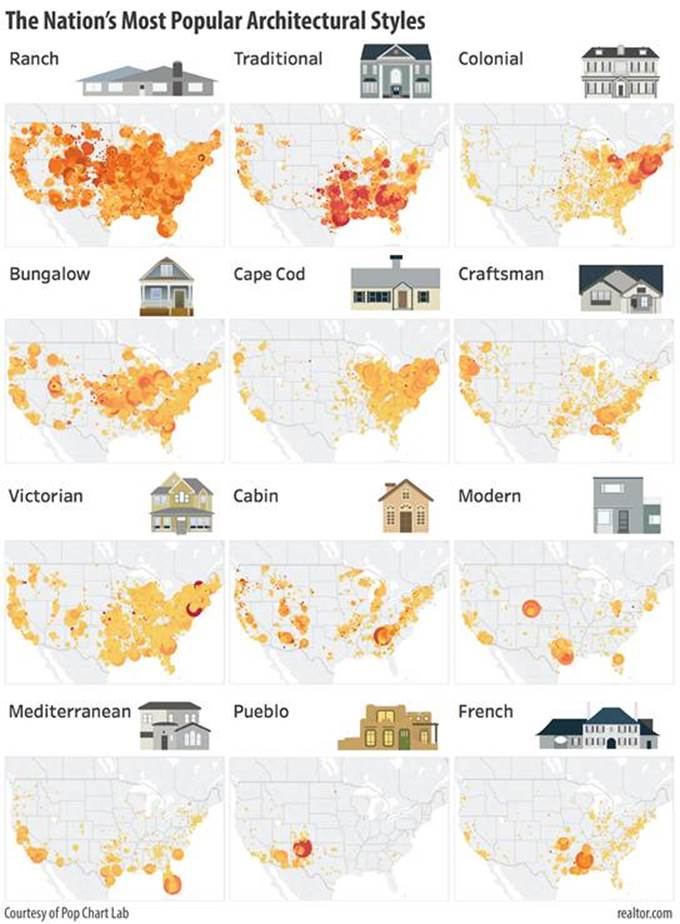
It’s worth emphasizing now more than ever: Diversity is what the United States of America is all about. The country, of course, was cobbled together on this very idea—diversity of geography, beliefs, people. And even the homes they live in! We’ve got architectural styles rooted in the history of our nation before it was a nation (Colonial, Pueblo), a variety of imports (Spanish, French, Mediterranean) and lots of utterly contemporary styles.

So what is an American home, really? It might be easier to come up with a definitive answer to the question: What’s the ultimate American TV show or ’80s rock band? (For the record, “Breaking Bad,” and the Replacements, respectively). But just as with pop culture or food, there are some tastes that unite us and others that are regional preferences.

We thought it was the ideal time to dive deep into our own data to find the architectural home styles that best define our nation. We looked into realtor.com®’s listing descriptions to find out which types of homes are mentioned the most, where they are most popular, and whether their prices are going up or down as they fade in and out of vogue.

Here’s what we found: some seemingly ironclad regional preferences. Some changes. A few surprises. And one clear winner for the title of the American home.

Most regional architectural styles in the United States have their roots both in history and in the environment: They grew out of the types of building materials, such as stone, wood, or clay (for bricks), that were readily available during the early period of development, and the climates that these homes were constructed to withstand, says architect Mark Hogan of OpenScope Studio in San Francisco. They were also often reminiscent of popular styles in the regions where the builders and buyers hailed from—including European influences for Spanish, French, and Tuscan-style homes.

For those reasons, “when people were first settling the West Coast … it ended up looking very different than what was being built on the East Coast at the same time,” Hogan says. “They were very limited to what [materials] they could find nearby.”

And yet there is one style that has managed to conquer most of the nation. Drumroll, please. The most popular home style in 29 of the 50 states is….

The ranch home.

To housing experts, this is no surprise. Ranch houses can be built quickly and inexpensively and can be customized easily to suit the whims of buyers. Although the low-slung style is inspired by the Old West, it spread across the country with the rise of automobile culture in the 1960s. Able to accommodate one or two cars, the sprawling homes quickly populated the new suburbs.

“The ranch style signals a lifestyle change of that age. Front porches went away, and people are more into backyard living and protecting privacy,” says Tim Cannan, president of PreservationDirectory.com.

The second most popular architectural style is the “traditional,” a somewhat vague classification encompassing a variety of classic designs, defined by simple rooflines and symmetrical windows, …read more

From:: Finance and Economy