Revised Obamacare-repeal bill would benefit holdout senators’ states: reports

A revised version of the Graham-Cassidy bill to repeal Obamacare would benefit states of senators who are currently opposed to the bill, according to reports late Sunday. According to both Politico and the Washington Post, which have seen the revised text, the new bill projects federal funding increases for Arizona, Alaska, Kentucky and Maine, each of which would have seen less federal funding under the original plan. Those states are home to Sens. John McCain, Lisa Murkowski, Rand Paul and Susan Collins, respectively, who have all come out opposed to the bill. The revision will reportedly be unveiled Monday. It faces a Saturday deadline for passage, and the GOP can only afford two dissenting votes. On Sunday, Texas Sen. Ted Cruz also said he opposed the bill, and suggested Utah Sen. Mike Lee did as well.

Market Pulse Stories are Rapid-fire, short news bursts on stocks and markets as they move. Visit MarketWatch.com for more information on this news.

…read more

From:: Stock Market News

Obama gave Facebook’s Zuckerberg a ‘wake-up call’ on fake news following election: report

President Barack Obama gave Facebook Inc. Chief Executive Mark Zuckerberg “a wake-up call” last November over Russia’s use of social media to meddle in the U.S. election, according to a Washington Post report Sunday. On Nov. 19, nine days after Zuckerberg called the idea that Facebook ads played a key role in the election “crazy,” Obama told Zuckerberg of the damage political disinformation had played, and warned his company needed to do more to address the threat. While Zuckerberg reportedly downplayed Facebook’s impact in his talk with Obama, last week Zuckerberg announced broad changes in how Facebook deals with political ads, and turned over 3,000 Russia-linked ads to congressional investigators. “I don’t want anyone to use our tools to undermine democracy,” Zuckerberg said in a video.

Market Pulse Stories are Rapid-fire, short news bursts on stocks and markets as they move. Visit MarketWatch.com for more information on this news.

…read more

From:: Stock Market News

White House imposes new travel restrictions against 8 countries, including Venezuela

The White House on Sunday announced new travel restrictions from visitors from eight countries, as President Donald Trump’s temporary travel ban targeting six mostly Muslim countries gets reshaped into permanent policy. The new restrictions single out Chad, Iran, Libya, North Korea, Somalia, Syria, Venezuela and Yemen. Chad, North Korea, and Venezuela were not part of the earlier travel ban. The White House said the new restrictions will take effect immediately for those without “bona fide” close relatives in the U.S., and Oct. 18 for those who do, as well as for citizens of Chad, North Korea and Venezuela. U.S. visa holders will not be affected. The countries affected have “‘inadequate’ identity-management protocols, information-sharing practices, and risk factors,” the White House said in a statement. The restrictions will be tailored for each country, and will remain in place until the Department of Homeland Security deems sufficient improvements have been made in those countries. When asked about the new travel ban Sunday, Trump told reporters: “The tougher, the better.”

Market Pulse Stories are Rapid-fire, short news bursts on stocks and markets as they move. Visit MarketWatch.com for more information on this news.

…read more

From:: Stock Market News

Milo Yiannopoulos’s appearance at UC Berkeley fizzles

An appearance by right-wing provocateur Milo Yiannopoulos at UC Berkeley fizzled Sunday, and a university spokesman dubbed his visit “the most expensive photo opp in the university’s history,” according to the East Bay Times. Amid heightened security, Yiannopoulos showed up at Sproul Plaza for about 15 minutes before being whisked off in an SUV. Yiannopoulos briefly met with his supporters, who were vastly outnumbered by protesters and police. The university estimated security for the brief event cost $800,000, and used the resources of eight police departments. Yiannopoulos had originally been scheduled to speak as the university kicked off “Free Speech Week,” which its student-group sponsors canceled last week. Berkeley police had been bracing for potential violence between Yiannopoulos supporters and protesters, but there were no immediate reports of violence or property damage.

Market Pulse Stories are Rapid-fire, short news bursts on stocks and markets as they move. Visit MarketWatch.com for more information on this news.

…read more

From:: Stock Market News

Big Data, Big Opportunities: How Predictive Analytics Is Changing the Business of Real Estate

By Suzanne De Vita

“This year the human race is producing more data than the previous 5,000 years combined. Data is so powerful that in the future, nation states will fight over it for power.”

This thought-provoking statistic set the stage for a much-anticipated panel discussion at RISMedia’s 2017 Real Estate CEO Exchange in New York on how brokers are leveraging the application of predictive analytics and big data in their businesses to better serve consumers’ real estate needs.

The opening remarks, presented by panel moderator Dave Garland, partner, Second Century Ventures and director of Strategic Investments for the National Association of REALTORS®, led the way for an engaging discussion with several industry leaders on the forefront of using predictive analytics and big data in real estate to change the way their business is being conducted now and into the future.

So what is predictive analytics, and why is it so important to the real estate industry? Simply put, “Predictive analytics is analyzing extracted data, using old data to predict the future,” Garland explained. “The big difference now is we have new data points that we can apply to our industry. We’re moving from the idea of hindsight to insight to foresight.”

The idea of using data in real estate isn’t new—think tax records, comps, valuations, or even local school, business and crime statistics. But with consumers demanding more and more information, and more data being available on consumer behavior than ever before, the use of predictive analytics—being able to accurately show buyers and sellers what their home will be worth in the future, backed up by data science—is the game-changer.

“‘Big data’ sounds like it’s really far out there, but earlier today I had a meeting downtown and on my phone, it said it’s going to take me 28 minutes to get to the next place I was going, and here’s an Uber so you can get there,” said Jeremy Sicklick, co-founder and CEO of HouseCanary. “The fact that it knew where I was, where my next meeting was and what the traffic was, and linked to an Uber to get me there—that is predictive analytics. So what does that look like in real estate over time?”

HouseCanary CEO and Co-Founder Jeremy Sicklick discusses predictive analytics during RISMedia’s 2017 CEO Exchange session “A Better Crystal Ball: How to Leverage Predictive Analytics.”

San Francisco-based HouseCanary is a real estate analytics company using data science to accurately value and forecast over 18,000 U.S. zip codes, 3 million blocks and 100 million properties.

Sicklick said one of the key opportunities predictive analytics provides in real estate is having the ability to know the property value of a home, and knowing where the value is going to go, to help consumers make better home-buying and -selling decisions. HouseCanary’s home value reports also allow users to add or remove properties or property details to instantly adjust a home’s comparable value, for example, or add a bathroom or remodel the kitchen and see how that affects the home’s value.

Arming the agent with that kind of …read more

From:: Real Estate News

Cilo Marbella: Luxury Living on the Costa del Sol

By Suzanne De Vita

Jason_Higgs

Located in the Malaga region of Spain’s famed southern coast, Cilo Marbella Luxury Real Estate was created by two luxury real estate experts, Jason Higgs and Dr. Miguel Horvath. From beachfront apartments to villas in the hills of the Sierra Blanca, Cilo Marbella services a wide variety of international clientele through offices in Marbella, Spain and London. Here, Higgs, the firm’s director, shares insights about the market, the firm’s strategies and the opportunities and challenges that lie ahead.

When was the firm founded?
Jason Higgs: We have been in business for seven years as Cilo Marbella, although I’ve been working in real estate in Marbella for 19 years. We operate within a 30-minute radius of Marbella.

What makes your company different? How do you position yourselves in the market?
JH: We like to think we know the market well from our almost 20 years of experience. We prefer to work with small-volume/high-value clients for sales and rentals.

Please describe current market conditions.
JH: The market is still fairly quiet at prices above 500,000 euros (approximately $587,000). The worldwide financial crisis hit Spain especially hard. Green shoots are certainly appearing at the lower price levels, and very small levels of growth are starting to show in the middle market, as well. Some properties have been on the market for years. This tends to happen when the owner has not faced up to new market realities.

How have home prices fluctuated in recent years?
JH: Prices have stabilized in the past 2-3 years; confidence is slowly returning.

Tell us about the types of properties in your market and which are most popular.
JH: Marbella remains (together with Cannes, St. Tropez, and the entire French Riviera) the leading luxury Mediterranean resort. Accordingly, we have an array of outstanding properties. These include beachfront mansions for 50 million euros, beachfront apartments for 3 million euros, gated community mansions for 5-15 million euros, etc. Apartments under 500,000 euros are most popular at the moment.

How do you market your listings?
JH: Mostly online through portals. Occasionally, through print as well.

What is the status of new construction in your area?
JH: It is gradually picking up. This is a good barometer that activity is returning to the market.

What types of buyers do you work with?
JH: Our buyers are almost exclusively international. The Russian market used to be strong, but has dipped due to lower oil prices and imposition of sanctions. The Middle East remains of interest, but again, not as strong as before. Scandinavians are a strong segment, but they tend to purchase at the lower end, rather than the higher end.

What are the needs and expectations of homebuyers and sellers in your market, and how do you serve those needs?
JH: Buyers and sellers alike can be unrealistic in their expectations. Realistic sellers are glad to get offers in the same ballpark as the asking price. Buyers sometimes think they can get “something for nothing.” As ever, it is a case of managing expectations.

What are the firm’s biggest challenges? What role do geopolitics play in your success?
JH: We seek economic …read more

From:: Real Estate News

Cilo Marbella: Luxury Living on the Costa del Sol

By Suzanne De Vita

Jason_Higgs

Located in the Malaga region of Spain’s famed southern coast, Cilo Marbella Luxury Real Estate was created by two luxury real estate experts, Jason Higgs and Dr. Miguel Horvath. From beachfront apartments to villas in the hills of the Sierra Blanca, Cilo Marbella services a wide variety of international clientele through offices in Marbella, Spain and London. Here, Higgs, the firm’s director, shares insights about the market, the firm’s strategies and the opportunities and challenges that lie ahead.

When was the firm founded?
Jason Higgs: We have been in business for seven years as Cilo Marbella, although I’ve been working in real estate in Marbella for 19 years. We operate within a 30-minute radius of Marbella.

What makes your company different? How do you position yourselves in the market?
JH: We like to think we know the market well from our almost 20 years of experience. We prefer to work with small-volume/high-value clients for sales and rentals.

Please describe current market conditions.
JH: The market is still fairly quiet at prices above 500,000 euros (approximately $587,000). The worldwide financial crisis hit Spain especially hard. Green shoots are certainly appearing at the lower price levels, and very small levels of growth are starting to show in the middle market, as well. Some properties have been on the market for years. This tends to happen when the owner has not faced up to new market realities.

How have home prices fluctuated in recent years?
JH: Prices have stabilized in the past 2-3 years; confidence is slowly returning.

Tell us about the types of properties in your market and which are most popular.
JH: Marbella remains (together with Cannes, St. Tropez, and the entire French Riviera) the leading luxury Mediterranean resort. Accordingly, we have an array of outstanding properties. These include beachfront mansions for 50 million euros, beachfront apartments for 3 million euros, gated community mansions for 5-15 million euros, etc. Apartments under 500,000 euros are most popular at the moment.

How do you market your listings?
JH: Mostly online through portals. Occasionally, through print as well.

What is the status of new construction in your area?
JH: It is gradually picking up. This is a good barometer that activity is returning to the market.

What types of buyers do you work with?
JH: Our buyers are almost exclusively international. The Russian market used to be strong, but has dipped due to lower oil prices and imposition of sanctions. The Middle East remains of interest, but again, not as strong as before. Scandinavians are a strong segment, but they tend to purchase at the lower end, rather than the higher end.

What are the needs and expectations of homebuyers and sellers in your market, and how do you serve those needs?
JH: Buyers and sellers alike can be unrealistic in their expectations. Realistic sellers are glad to get offers in the same ballpark as the asking price. Buyers sometimes think they can get “something for nothing.” As ever, it is a case of managing expectations.

What are the firm’s biggest challenges? What role do geopolitics play in your success?
JH: We seek economic …read more

From:: Real Estate News

Entry-Level Housing Recovery Unsteady

By Suzanne De Vita

Zillow_August_Home_Values

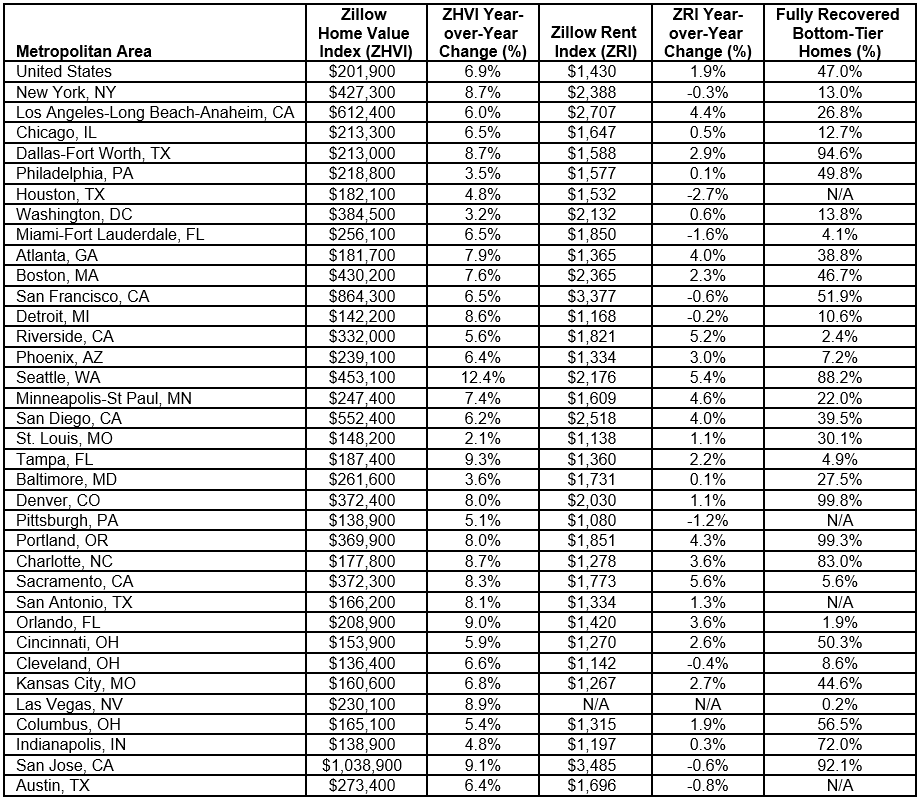
Entry-level homes came in last in the recession, hit hard by sinking values—and now, they are the last to recover, according to the August Zillow® Real Estate Market Reports. Starter homes in 24 of the 35 largest metropolitan areas, or roughly 69 percent, are struggling to regain value, even with the national median value up 6.9 percent year-over-year.

“The housing market as a whole is moving at a steady clip, with high demand and low inventory combining to maintain strong home value appreciation,” says Dr. Svenja Gudell, chief economist at Zillow. “Most new construction has been at the higher end of the market, so demand for the limited supply of entry-level homes is pushing up their values—but these homes also lost more value when the bubble burst. Many of these homeowners are still waiting to see their homes come back to where they were about 10 years ago. Even as headline numbers show an overall recovery, there are still thousands of Americans struggling to bounce back from the housing bust.”

Over 50 percent of homes nationwide, however, have recovered—and then some. In August, the national median value in the Zillow Home Value Index (ZHVI) was $201,900.

There are now 12.6 percent fewer homes for sale compared to one year ago, the Reports show. The national median rent in the Zillow Rent Index (ZRI), meanwhile, has posted an annual gain of 1.9 percent, with the median rent totaling $1,430.

For more information, please visit www.zillow.com.

Suzanne De Vita is RISMedia’s online news editor. Email her your real estate news ideas at sdevita@rismedia.com.

For the latest real estate news and trends, bookmark RISMedia.com.

The post Entry-Level Housing Recovery Unsteady appeared first on RISMedia.

…read more

From:: Real Estate News

Entry-Level Housing Recovery Unsteady

By Suzanne De Vita

Zillow_August_Home_Values

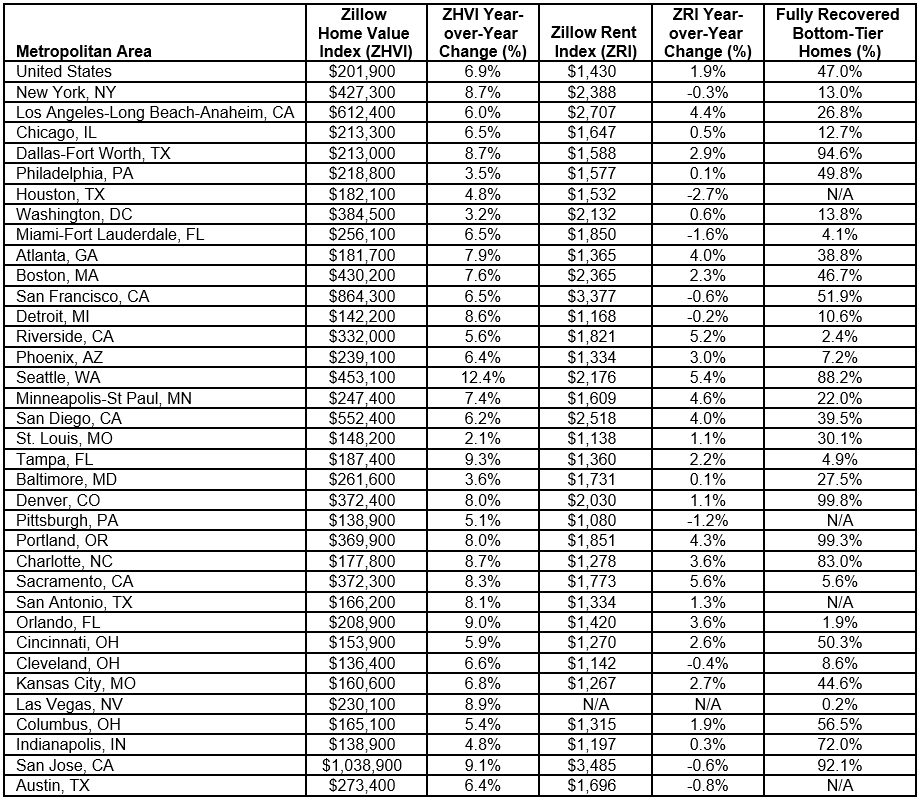
Entry-level homes came in last in the recession, hit hard by sinking values—and now, they are the last to recover, according to the August Zillow® Real Estate Market Reports. Starter homes in 24 of the 35 largest metropolitan areas, or roughly 69 percent, are struggling to regain value, even with the national median value up 6.9 percent year-over-year.

“The housing market as a whole is moving at a steady clip, with high demand and low inventory combining to maintain strong home value appreciation,” says Dr. Svenja Gudell, chief economist at Zillow. “Most new construction has been at the higher end of the market, so demand for the limited supply of entry-level homes is pushing up their values—but these homes also lost more value when the bubble burst. Many of these homeowners are still waiting to see their homes come back to where they were about 10 years ago. Even as headline numbers show an overall recovery, there are still thousands of Americans struggling to bounce back from the housing bust.”

Over 50 percent of homes nationwide, however, have recovered—and then some. In August, the national median value in the Zillow Home Value Index (ZHVI) was $201,900.

There are now 12.6 percent fewer homes for sale compared to one year ago, the Reports show. The national median rent in the Zillow Rent Index (ZRI), meanwhile, has posted an annual gain of 1.9 percent, with the median rent totaling $1,430.

For more information, please visit www.zillow.com.

Suzanne De Vita is RISMedia’s online news editor. Email her your real estate news ideas at sdevita@rismedia.com.

For the latest real estate news and trends, bookmark RISMedia.com.

The post Entry-Level Housing Recovery Unsteady appeared first on RISMedia.

…read more

From:: Finance and Economy

Riding the Wave in South Carolina

By Suzanne De Vita

A rising tide lifts all boats, as the saying goes, and for ERA Wilder Realty, this past year has been about cresting an incredible wave of momentum.

According to Eddie Wilder, president and CEO of the Columbia, S.C.-based firm he founded in 1995, he’s always aspired to be better.

“You’re only as good as the people around you,” he remarks. And to that end, he’s assembled both a dynamic leadership team and an energized roster of sales professionals.

When he affiliated with ERA Real Estate in 2001, it was because the brand’s culture fit so well with his.

“We’re always looking for the best tools, and we try to be an early adopter. We’re not afraid to take a risk in order to grow,” says Wilder. “ERA Real Estate’s reputation as an innovator fits with our winning mindset.”

This past year, that winning mindset manifested itself in a number of industry accolades recognizing performance, service excellence and commitment to community. As a top 10 company in the ERA® system and a CARTUS Cup finalist for outstanding relocation service, ERA Wilder Realty not only ranked high in production, but the firm also produced the brand’s national Rookie of the Year, was honored with ERA’s Circle of Light Award for Community Leadership, and was recognized as one of the top three fundraisers for ERA’s signature charity, the Muscular Dystrophy Association.

Commitment to community is an integral part of the company’s culture, complementing a set of core values recently formalized across the entire company of 10 offices and 260 agents.

“Our core values are to approach our profession and each other with a positive attitude; to conduct ourselves in a professional manner as honesty and integrity guide our decisions; to respect each other’s time, differences, perspectives, feelings and opinions; and to embody the spirit of teamwork,” says Wilder.

The company’s core values have also supported recruitment efforts.

“It’s more than a code,” says Wilder. “It’s a lifestyle that defines our company.”

While success may be a word that has defined ERA Wilder Realty over the years, Wilder wanted more. To that end, he and his leadership team recently implemented a new approach to running the company based on Gino Wickman’s book “Traction: Get a Grip on Your Business.” Wickman’s Entrepreneurial Operating System suggests simple ways to realign a company to provide the leadership team with more focus, more growth, and more enjoyment.

The process involved taking a hard look at the team’s strengths and weaknesses and putting the right people in the right roles. That meant getting Wilder out of the management weeds and allowing him to focus on being the company visionary, while delegating operator responsibilities to others. The result has been increased communication and efficiency—a plus for the entire company.

It’s a process that was shared as a best practice during the ERA Young Leaders Network summer retreat, which ERA Wilder Realty hosted in early August. During this three-day event, more than 40 ERA colleagues who are currently in a leadership role—or being groomed for one—immerse themselves in a host company’s business, learning …read more

From:: Real Estate News