Campbell Soup says Pacific Foods lawsuit puts deal at risk

Campbell Food Co. said late Wednesday that a lawsuit brought by the estate of a former Pacific Foods shareholder against Pacific Foods “creates an impediment” to the closing of the $700 million deal, announced in July, even as Campbell is not named in the suit. Campbell said it notified Pacific Foods on Wednesday that the company has 60 days under the terms of the agreement to resolve the issues arising from the suit if the transaction is to be completed. After that period, Campbell “has the option to extend the cure period or terminate the agreement,” the company said in a statement. Shares of Campbell were flat in late trading after ending the regular session up 0.8%.

Market Pulse Stories are Rapid-fire, short news bursts on stocks and markets as they move. Visit MarketWatch.com for more information on this news.

…read more

From:: Stock Market News

Thor shares rise after hours on earnings beat

Thor Industries Inc. shares rose in the extended session Wednesday after the recreational-vehicles maker topped Wall Street estimates for the quarter. Thor shares advanced 3.3% to $123.89 after hours. The company reported fiscal fourth-quarter net income of $119.5 million, or $2.26 a share, compared to $82.8 million, or $1.57 a share, in the year-ago period. Revenue rose to $1.93 billion from $1.29 billion in the year-ago period. Analysts surveyed by FactSet had estimated $1.96 a share on revenue of $1.82 billion.

Market Pulse Stories are Rapid-fire, short news bursts on stocks and markets as they move. Visit MarketWatch.com for more information on this news.

…read more

From:: Stock Market News

[Video] Cordray says Equifax, Experian and TransUnion to all face increased scrutiny

While credit report agencies Experian and TransUnion weren’t part of Equifax’s massive data breach, they will definitely face increased regulatory scrutiny because of it. Consumer Financial Protection Bureau Director Richard Cordray outlined in an interview with CNBC what he thinks is necessary in order to not have a breach of this size happen again. …read more

From:: Real Estate Wire

Pier 1 shares fall as company posts wider quarterly loss

Shares of Pier 1 Imports Inc. fell more than 7% late Wednesday after the retailer reported a wider-than-expected loss in the fiscal second quarter and forecast a smaller per-share profit for fiscal year 2018 than what analysts had expected. Pier 1 said it lost $7.8 million, or 10 cents a share, in the fiscal first quarter, compared with a loss of $4 million, or 5 cents a share, in the year-ago quarter. Adjusted for one-time items, the company reported a loss of 5 cents a share in the quarter. Revenue rose 0.4% to $407.6 million, compared with $405.8 million in the same period last year. Comparable-store sales rose 1.8% in the quarter. Analysts polled by FactSet had expected a loss of 6 cents a share on sales of $407 million, and a rise of 0.7% for comparable-store sales. The company updated its full-year outlook to “reflect the anticipated impact of hurricanes Harvey and Irma” on the third quarter. The new guidance calls for comparable-store sales to either slide 1% or rise 1% for the year, and flat to 25% higher sales growth. The company guided for a GAAP EPS between 31 cents and 41 cents for the year. The analysts surveyed by FactSet had expected a fiscal 2018 EPS of 46 cents a share. The stock had ended the regular trading session up 3.2%.

Market Pulse Stories are Rapid-fire, short news bursts on stocks and markets as they move. Visit MarketWatch.com for more information on this news.

…read more

From:: Stock Market News

Millennials Are Redefining Home-Buying Standards—and Gen Z Is Next

By Susanne Dwyer

The home-buying approach varies from generation to generation—and in order to overcome down payment hurdles, millennial buyers are transforming the standards of homeownership set by baby boomers, according to the 2017 Zillow Group Report. In fact, less than half (39 percent) of millennials submit offers with the recommended 20 percent down payment. Twenty-one percent put down the minimum: 5 percent or less.

The financial challenges don’t stop at down payments. Thirty-three percent of millennial buyers report having difficulty qualifying for a loan, and 43 percent have trouble finding out what they can afford. These complications likely stem from a lack of experience, as 71 percent of millennial buyers are purchasing their first home.

“In many cities across the U.S., the housing market is extremely competitive, especially for first-time buyers who are looking to purchase a starter home,” says Zillow Chief Economist Dr. Svenja Gudell. “Young buyers often start their careers in fast-growing cities in which the market is particularly tough—and they’re trying to save for a down payment while making record-high rent payments.”

Most millennials are not confident in their buying power. Sixty-two percent simultaneously search for rentals as a back-up in case of challenges in their home search, such as finding suitable properties in their price range or within their required time frame.

Millennials will, however, look for creative ways to achieve the home-buying dream. Twenty-nine percent of millennial buyers ask friends or family for down payment help, often coming up with the full amount using various sources.

Millennials will also jump on the opportunity to claim a home. They do not shy away from multiple offer situations, and are not afraid to go over budget. More than 53 percent of first-time millennial buyers make multiple offers on the homes they want, and 37 percent don’t keep to their financial plan. This can prevent future plans to sell if market conditions don’t allow the sale of the home to cover remaining mortgage balances. The typical homeowner still owes 62 percent of their home’s value and 46 percent of millennial sellers won’t sell their home in their desired price range.

The economic landscape may or may not change for the next generation, but they will likely tackle these financial challenges in their own way, the report shows. Generation Z is just now starting to enter the housing market as renters.

“It’s encouraging to see that Generation Z is inheriting the same notion of what home means as their parents and millennial siblings,” says Jeremy Wacksman, chief marketing officer at Zillow Group. “These tech-savvy yet risk-averse renters are bringing their social personalities home, desiring communal amenities geared toward bringing people together.”

While Generation Z buyers embrace homeownership as fundamental to achieving the American Dream, high rent prices may stand in the way when it comes time for them to buy. Thirty-seven percent of renters who didn’t move in the past year state that lack of affordability is the main reason for staying put.

Since 47 percent of Generation Z identifies as non-white, it is the most racially and …read more

From:: Real Estate News

Millennials Are Redefining Home-Buying Standards—and Gen Z Is Next

By Susanne Dwyer

The home-buying approach varies from generation to generation—and in order to overcome down payment hurdles, millennial buyers are transforming the standards of homeownership set by baby boomers, according to the 2017 Zillow Group Report. In fact, less than half (39 percent) of millennials submit offers with the recommended 20 percent down payment. Twenty-one percent put down the minimum: 5 percent or less.

The financial challenges don’t stop at down payments. Thirty-three percent of millennial buyers report having difficulty qualifying for a loan, and 43 percent have trouble finding out what they can afford. These complications likely stem from a lack of experience, as 71 percent of millennial buyers are purchasing their first home.

“In many cities across the U.S., the housing market is extremely competitive, especially for first-time buyers who are looking to purchase a starter home,” says Zillow Chief Economist Dr. Svenja Gudell. “Young buyers often start their careers in fast-growing cities in which the market is particularly tough—and they’re trying to save for a down payment while making record-high rent payments.”

Most millennials are not confident in their buying power. Sixty-two percent simultaneously search for rentals as a back-up in case of challenges in their home search, such as finding suitable properties in their price range or within their required time frame.

Millennials will, however, look for creative ways to achieve the home-buying dream. Twenty-nine percent of millennial buyers ask friends or family for down payment help, often coming up with the full amount using various sources.

Millennials will also jump on the opportunity to claim a home. They do not shy away from multiple offer situations, and are not afraid to go over budget. More than 53 percent of first-time millennial buyers make multiple offers on the homes they want, and 37 percent don’t keep to their financial plan. This can prevent future plans to sell if market conditions don’t allow the sale of the home to cover remaining mortgage balances. The typical homeowner still owes 62 percent of their home’s value and 46 percent of millennial sellers won’t sell their home in their desired price range.

The economic landscape may or may not change for the next generation, but they will likely tackle these financial challenges in their own way, the report shows. Generation Z is just now starting to enter the housing market as renters.

“It’s encouraging to see that Generation Z is inheriting the same notion of what home means as their parents and millennial siblings,” says Jeremy Wacksman, chief marketing officer at Zillow Group. “These tech-savvy yet risk-averse renters are bringing their social personalities home, desiring communal amenities geared toward bringing people together.”

While Generation Z buyers embrace homeownership as fundamental to achieving the American Dream, high rent prices may stand in the way when it comes time for them to buy. Thirty-seven percent of renters who didn’t move in the past year state that lack of affordability is the main reason for staying put.

Since 47 percent of Generation Z identifies as non-white, it is the most racially and …read more

From:: Finance and Economy

Pending Home Sales Underwhelm…Again

By Susanne Dwyer

Hurricanes Harvey, Irma Could Stop Existing Sales Short of 2016

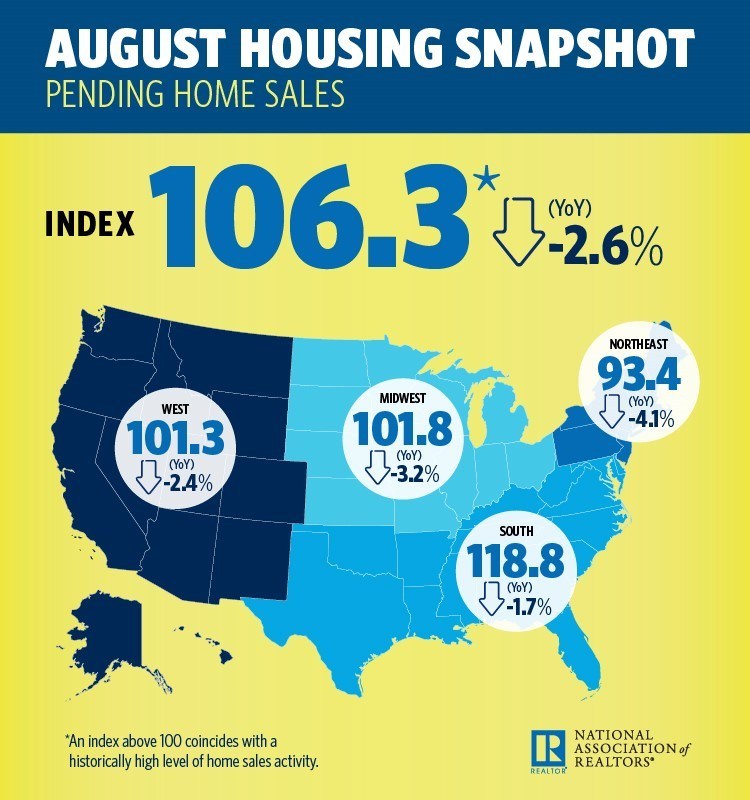
Pending home sales again underwhelmed in August, down 2.6 percent in the National Association of REALTORS® (NAR) Pending Home Sales Index (PHSI). The PHSI posted 106.3 in August, down from 109.1 in July. The Index is based on contract signings.

“August was another month of declining contract activity because of the one-two punch of limited listings and home prices rising far above incomes,” says Lawrence Yun, chief economist at NAR. “Demand continues to overwhelm supply in most of the country, and, as a result, many would-be buyers from earlier in the year are still in the market for a home, while others have perhaps decided to temporarily postpone their search.”

Dire inventory levels over the summer essentially stopped progress, Yun says. Hurricanes Harvey and Irma will contribute to a sales slowdown in the coming months in the South, as well—and potentially prevent existing-home sales for the year from surpassing their 2016 numbers.

“The supply and affordability headwinds would have likely held sales growth just a tad above last year, but coupled with the temporary effects from Hurricanes Harvey and Irma, sales in 2017 now appear will fall slightly below last year,” says Yun. “The good news is that nearly all of the missed closings for the remainder of the year will likely show up in 2018, with existing sales forecast to rise 6.9 percent.”

“The slip in pending home sales highlights continued challenges in inventory, especially affordable inventory,” says Danielle Hale, chief economist for realtor.com®. “Realtor.com data shows that listings were down 10 percent overall in August and 20 percent for listings priced under $200,000, so this is a challenge that will persist and likely hamper home sales through the rest of the year. Dampened activity from Hurricane Harvey is also weighing, and will lead to lower home sales activity in the months ahead.”

All of the four major regions in the U.S. saw decreases in the PHSI in August, with the Northeast down 4.4 percent to 93.4, the South down 3.5 percent to 118.8, the Midwest down 1.5 percent to 101.8, and the West down 1.0 percent to 101.3.

For more information, please visit www.nar.realtor.

For the latest real estate news and trends, bookmark RISMedia.com.

The post Pending Home Sales Underwhelm…Again appeared first on RISMedia.

…read more

From:: Real Estate News

Pending Home Sales Underwhelm…Again

By Susanne Dwyer

Hurricanes Harvey, Irma Could Stop Existing Sales Short of 2016

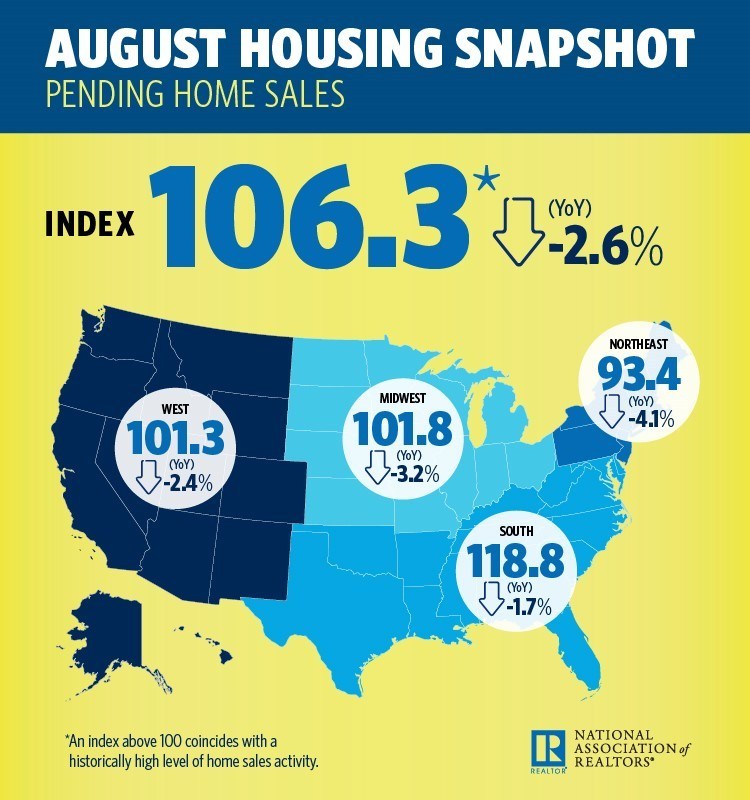
Pending home sales again underwhelmed in August, down 2.6 percent in the National Association of REALTORS® (NAR) Pending Home Sales Index (PHSI). The PHSI posted 106.3 in August, down from 109.1 in July. The Index is based on contract signings.

“August was another month of declining contract activity because of the one-two punch of limited listings and home prices rising far above incomes,” says Lawrence Yun, chief economist at NAR. “Demand continues to overwhelm supply in most of the country, and, as a result, many would-be buyers from earlier in the year are still in the market for a home, while others have perhaps decided to temporarily postpone their search.”

Dire inventory levels over the summer essentially stopped progress, Yun says. Hurricanes Harvey and Irma will contribute to a sales slowdown in the coming months in the South, as well—and potentially prevent existing-home sales for the year from surpassing their 2016 numbers.

“The supply and affordability headwinds would have likely held sales growth just a tad above last year, but coupled with the temporary effects from Hurricanes Harvey and Irma, sales in 2017 now appear will fall slightly below last year,” says Yun. “The good news is that nearly all of the missed closings for the remainder of the year will likely show up in 2018, with existing sales forecast to rise 6.9 percent.”

“The slip in pending home sales highlights continued challenges in inventory, especially affordable inventory,” says Danielle Hale, chief economist for realtor.com®. “Realtor.com data shows that listings were down 10 percent overall in August and 20 percent for listings priced under $200,000, so this is a challenge that will persist and likely hamper home sales through the rest of the year. Dampened activity from Hurricane Harvey is also weighing, and will lead to lower home sales activity in the months ahead.”

All of the four major regions in the U.S. saw decreases in the PHSI in August, with the Northeast down 4.4 percent to 93.4, the South down 3.5 percent to 118.8, the Midwest down 1.5 percent to 101.8, and the West down 1.0 percent to 101.3.

For more information, please visit www.nar.realtor.

For the latest real estate news and trends, bookmark RISMedia.com.

The post Pending Home Sales Underwhelm…Again appeared first on RISMedia.

…read more

From:: Finance and Economy