
Existing-Home Sales Slightly Stir in September

By Susanne Dwyer

Existing-home sales slightly stirred in September, posting higher than in August but lower than one year prior, the National Association of REALTORS® (NAR) reports.

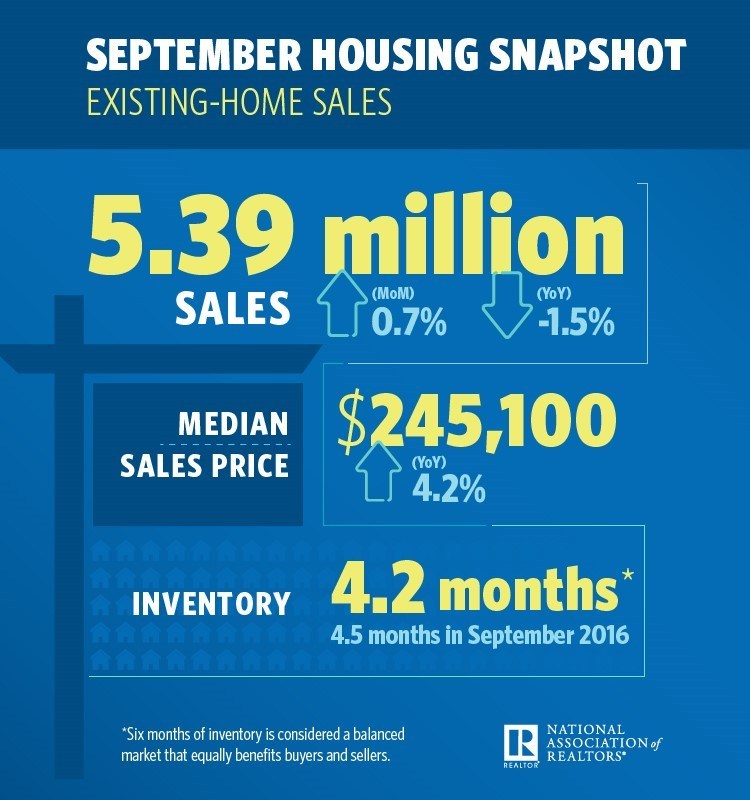
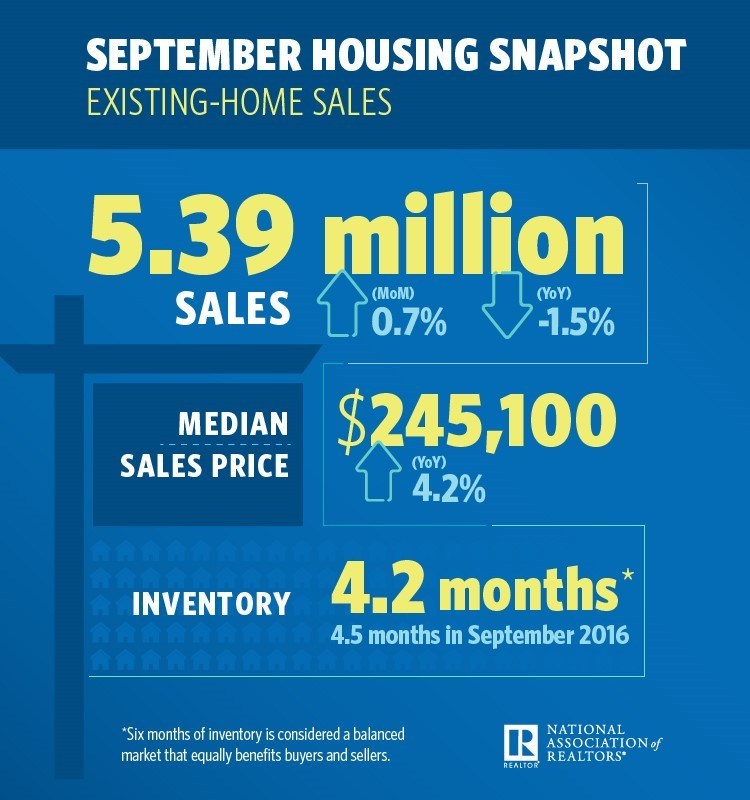
Existing-home sales totaled 5.39 million, a 0.7 percent increase from August but a 1.5 percent decrease from one year prior. Inventory increased 1.6 percent to 1.90 million, 6.4 percent below one year prior.

“Home sales in recent months remain at their lowest level of the year and are unable to break through, despite considerable buyer interest in most parts of the country,” says Lawrence Yun, chief economist at NAR. “REALTORS® this fall continue to say the primary impediments stifling sales growth are the same as they have been all year: not enough listings—especially at the lower end of the market—and fast-rising prices that are straining the budgets of prospective buyers.”

Inventory is currently at a 4.2-month supply. Existing homes averaged 34 days on market in September, five days less than one year prior. All told, 48 percent of homes sold in September were on the market for less than one month.

“Existing-home sales picked up momentum slightly in September compared to August, but were lower on a year-over-year basis for the first time since July 2016,” says Danielle Hale, chief economist for realtor.com®. “Inventories also continue to plunge, creating challenges for buyers across the country. On the bright side, we’re starting to see home price growth slow down, with sale prices up only 4.2 percent from a year ago.”

The metropolitan areas with the fewest days on market in September, according to data from realtor.com, were San Francisco-Oakland-Hayward, Calif. (30 days); San Jose-Sunnyvale-Santa Clara, Calif. (32 days); Salt Lake City, Utah (35 days); and Seattle-Tacoma-Bellevue, Wash., and Vallejo-Fairfield, Calif. (both 36 days).

The median existing-home price for all types of houses (single-family, condo, co-op and townhome) was $245,100, a 4.2 percent increase from one year prior. The median price for a single-family existing home was $246,800, while the median price for an existing condo was $231,300.

“A continuation of last month’s alleviating price growth, which was the slowest since last December (4.5 percent), would improve affordability conditions and be good news for the would-be buyers who have been held back by higher prices this year,” Yun says.

Single-family existing-home sales came in at 4.79 million in September, a 1.1 percent increase from 4.74 million in August, but a 1.2 percent decrease from 4.85 million one year prior. Existing-condo and -co-op sales came in at 600,000, a 1.6 percent decrease from August and a 3.2 percent decrease from one year prior.

Twenty percent of existing-home sales in September were all-cash, with 15 percent by individual investors. Four percent were distressed.

The Midwest and West saw positive activity in September, with existing-home sales rising 1.6 percent to 1.30 million in the Midwest, with a median price of $195,800, and 3.3 percent to 1.24 million in the West, with a median price of $362,700. Existing-home sales in the South fell, 0.9 percent to 2.13 million, with a median price of $215,100. Existing-home sales in the Northeast were …read more

From:: Finance and Economy

Jeff Bezos May Seek HQ2 Close to Home

By Susanne Dwyer

Editor’s Note: This was originally published on RISMedia’s blog, Housecall. See what else is cookin’ now at blog.rismedia.com:

Last month, Amazon announced the search for its second headquarters (HQ2). The online marketplace giant has not yet slipped about what city they are leaning towards. Perhaps a look at CEO Jeff Bezos’ real estate investments will give us an inkling.

Check out Bezos’ current homes. Are any of these located in a city that fits the bill for HQ2?

  • Bezos owns two homes in Beverly Hills. One was purchased in 2007 for $24.45 million, and the other was purchased this past July for $12.9 million.
  • He purchased the Washington, D.C. Textile Museum in October for $23 million. It is being renovated into a private residence by architect Ankie Barnes.
  • He bought a 1920s ranch in Culberson County, Texas to recreate the feeling of the Lazy G, a Texas ranch his grandfather retired in and the place Bezos spent summers at.
  • He purchased three units in New York City for $7.65 million, and also bought the next door unit for $5.3 million in 2012.
  • He bought a 5.3-acre property for $10 million in Medina, Wash., in 1998. He built another property on the lot in 2004, and bought the property next door in 2010.

California
While his Beverly Hills location doesn’t meet Amazon’s population requirement of more than 1 million people, the city is surrounded by heavily populated cities such as Los Angeles, West Hollywood and Santa Monica. According to the 2010 U.S. Census of Population & Housing, most residents (about 55 percent) are under 44 years of age—an important dynamic if Amazon is looking to hire young talent. Realtor.com® reports California is on their hottest markets list; however, the state’s lack of affordable housing may be a risk factor for Amazon.

Washington, D.C.
If a diverse population is what Amazon is looking for, then Washington, D.C. may be the best choice. The city has a reputation for being a meeting place of different cultures, ages and experiences. Transportation can also be a benefit, as Washington boasts the cleanest and most efficient transportation systems in the world. Zillow reports Washington, D.C. is a very hot real estate market, with home values up 3.2 percent year-over-year.

Texas
While Culberson County may not be what Amazon has in mind for its next big location, more populous cities like Austin and Dallas may be in the running. Out of the two, Dallas may be a better fit transportation-wise, as Austin can be limiting if Amazon wants an easy access city. Austin, however, has a reputation for offering a unique culture and may work better for Amazon’s search for a “happy” city.

In terms of real estate, the Dallas markets are healthy, with home values up 2.9 percent year-over-year, according to the August Zillow Real Estate Market Reports.

New York
The Big Apple checks off a lot …read more

From:: Real Estate News

Jeff Bezos May Seek HQ2 Close to Home

By Susanne Dwyer

Editor’s Note: This was originally published on RISMedia’s blog, Housecall. See what else is cookin’ now at blog.rismedia.com:

Last month, Amazon announced the search for its second headquarters (HQ2). The online marketplace giant has not yet slipped about what city they are leaning towards. Perhaps a look at CEO Jeff Bezos’ real estate investments will give us an inkling.

Check out Bezos’ current homes. Are any of these located in a city that fits the bill for HQ2?

  • Bezos owns two homes in Beverly Hills. One was purchased in 2007 for $24.45 million, and the other was purchased this past July for $12.9 million.
  • He purchased the Washington, D.C. Textile Museum in October for $23 million. It is being renovated into a private residence by architect Ankie Barnes.
  • He bought a 1920s ranch in Culberson County, Texas to recreate the feeling of the Lazy G, a Texas ranch his grandfather retired in and the place Bezos spent summers at.
  • He purchased three units in New York City for $7.65 million, and also bought the next door unit for $5.3 million in 2012.
  • He bought a 5.3-acre property for $10 million in Medina, Wash., in 1998. He built another property on the lot in 2004, and bought the property next door in 2010.

California
While his Beverly Hills location doesn’t meet Amazon’s population requirement of more than 1 million people, the city is surrounded by heavily populated cities such as Los Angeles, West Hollywood and Santa Monica. According to the 2010 U.S. Census of Population & Housing, most residents (about 55 percent) are under 44 years of age—an important dynamic if Amazon is looking to hire young talent. Realtor.com® reports California is on their hottest markets list; however, the state’s lack of affordable housing may be a risk factor for Amazon.

Washington, D.C.
If a diverse population is what Amazon is looking for, then Washington, D.C. may be the best choice. The city has a reputation for being a meeting place of different cultures, ages and experiences. Transportation can also be a benefit, as Washington boasts the cleanest and most efficient transportation systems in the world. Zillow reports Washington, D.C. is a very hot real estate market, with home values up 3.2 percent year-over-year.

Texas
While Culberson County may not be what Amazon has in mind for its next big location, more populous cities like Austin and Dallas may be in the running. Out of the two, Dallas may be a better fit transportation-wise, as Austin can be limiting if Amazon wants an easy access city. Austin, however, has a reputation for offering a unique culture and may work better for Amazon’s search for a “happy” city.

In terms of real estate, the Dallas markets are healthy, with home values up 2.9 percent year-over-year, according to the August Zillow Real Estate Market Reports.

New York
The Big Apple checks off a lot …read more

From:: Finance and Economy

.realtor™ Adds Powerful Productivity Tools to Its Trusted Platform

By Susanne Dwyer

How do you define “trust?” In the real estate industry, it implies several qualities, including competence, reliability, professionalism and honesty. Trust must be earned, but it’s also subject to first impressions. In the online world, those first impressions can be encouraged (or discouraged) by something as simple as your domain name.

Therefore, establishing trust is one of the many reasons members of the National Association of REALTORS® (NAR) have been claiming their .realtor™ domains. Exclusively available to members, firms and NAR boards (and the Canadian Real Estate Association), a domain name ending in .realtor™ is an excellent way to make a lasting impression on prospects and clients by reminding them who you are and what you do.

Much More Than a Domain
Since the .realtor™ top-level domains were first offered, several enhancements have been integrated into the platform, including easy-to-build IDX-powered websites (from Placester®, a REALTOR Benefits® Program Partner) and a free realtor.com® profile website (these two benefits are currently for U.S. members only).

In addition to these excellent marketing tools, .realtor™ now offers best-in-class communication and productivity tools, making it easy for members to incorporate professional email from G Suite, as well as other G Suite applications. By taking advantage of .realtor™’s entire digital toolkit, members can propel their real estate business forward, leveraging web solutions designed to improve their marketing efforts and maximize their business efficiencies.

G Suite is a product from Google Cloud, consisting of cloud computing, productivity and collaboration tools, originally launched in 2006 (as Google Apps for Work). Since then, the breadth and depth of its applications have grown, now including a robust integration of email, cloud storage, word processing, spreadsheets, presentation tools, shared calendars, and more.

All the work you do with your .realtor™ domain on G Suite is instantly backed up by Google’s data centers and synchronized for access on any of your devices. Further, Google’s search capabilities are built into all G Suite products—a huge time-saver if you’re on the go and trying to locate old emails, files, etc.

Your .realtor™ domain includes several additional benefits:

  • Professional email (for example, info@john.realtor instead of JohnMorgan@gmail.com)
  • Double the amount of cloud storage that you get with a free Gmail account
  • Direct U.S.-based customer support through .realtor™
  • An advertisement-free email experience

Anyone can set up G Suite and run their business email through Gmail, although the process requires several steps in order for your domain’s MX records to point to Google servers. With a .realtor™ domain, the process is managed for you. All you need to do is follow a few simple screen-by-screen steps, and the .realtor™ team takes it from there.

Available G Suite Applications for Real Estate
Google Cloud’s collection of G Suite applications can truly streamline an agent’s busy digital life. A few examples:

Open houses – Use Google Forms (on a tablet) to effortlessly compile visitor data and manage follow-up.

On-the-go meetings – Use Hangouts for easy-to-join video conversations with clients and office members.

Store anything/retrieve anywhere – Google Drive’s cloud-based storage simplifies organizing and retrieving client photos, transaction files, listing presentations, etc., on any device.

Customer relationship management …read more

From:: Real Estate News

Forecast: Commercial to Grow ‘Moderately’ Through 2019

By Susanne Dwyer

A recent forecast out of the Urban Land Institute’s (ULI) Center for Capital Markets and Real Estate predicts moderate growth for the commercial real estate industry through 2019.

The ULI Real Estate Economic Forecast, a semi-annual projection based on survey responses, anticipates commercial real estate will see $450 billion in transaction volume in 2017 and $427 billion in volume in 2018 and 2019. All are declines from the previous year. On the broader economy, the forecast expects GDP to grow 2.2 percent in 2017 and 2.4 percent in 2018.

“Respondents to the October 2017 ULI Real Estate Economic Forecast downplayed the possibility of a spike in economic growth through 2019,” said William Maher, director of North American Strategy and Research at LaSalle Investment Management, leader at ULI and a survey respondent. “At the same time, they confirmed that the current expansion could become the longest one since records were kept starting in the 19th century. While real estate will benefit from continued growth, U.S. property markets are close to equilibrium, which should result in inflationary rent growth and returns in the single digits for core real estate and equity real estate investment trusts (REITs).”

The forecast expects 960,000 single-family housing starts in 2019, and home prices to appreciate an average 4.8 percent through 2019.

Source: Urban Land Institute (ULI)

For the latest real estate news and trends, bookmark RISMedia.com.

The post Forecast: Commercial to Grow ‘Moderately’ Through 2019 appeared first on RISMedia.

…read more

From:: Real Estate News

Forecast: Commercial to Grow ‘Moderately’ Through 2019

By Susanne Dwyer

A recent forecast out of the Urban Land Institute’s (ULI) Center for Capital Markets and Real Estate predicts moderate growth for the commercial real estate industry through 2019.

The ULI Real Estate Economic Forecast, a semi-annual projection based on survey responses, anticipates commercial real estate will see $450 billion in transaction volume in 2017 and $427 billion in volume in 2018 and 2019. All are declines from the previous year. On the broader economy, the forecast expects GDP to grow 2.2 percent in 2017 and 2.4 percent in 2018.

“Respondents to the October 2017 ULI Real Estate Economic Forecast downplayed the possibility of a spike in economic growth through 2019,” said William Maher, director of North American Strategy and Research at LaSalle Investment Management, leader at ULI and a survey respondent. “At the same time, they confirmed that the current expansion could become the longest one since records were kept starting in the 19th century. While real estate will benefit from continued growth, U.S. property markets are close to equilibrium, which should result in inflationary rent growth and returns in the single digits for core real estate and equity real estate investment trusts (REITs).”

The forecast expects 960,000 single-family housing starts in 2019, and home prices to appreciate an average 4.8 percent through 2019.

Source: Urban Land Institute (ULI)

For the latest real estate news and trends, bookmark RISMedia.com.

The post Forecast: Commercial to Grow ‘Moderately’ Through 2019 appeared first on RISMedia.

…read more

From:: Finance and Economy

West Leads Modest Rise in Existing Home Sales

The first increase in existing home sales during the last four months was led by sales in the West. Hurricanes likely restrained activity in the South.

Sales of pre-owned single-family houses, townhomes, condominiums and co-operatives during September were determined to be a preliminary 465,000 units.

Last month’s existing home sales brought the total for all nine months that have elapsed so far this year to 4.204 million residential units.


…read more

From:: Financing

Stocks close at records on tax cut hopes

U.S. benchmark stock indexes all rose on Friday to close at record levels after the Senate adopted a federal budget for next year, a key step on the road to tax cuts. The Dow Jones Industrial Average advanced 164 points to 23326, and was up 2.0% for the week. The Nasdaq Composite Index gained 24 points at 6629. The S&P 500 was up 13 points to 2575, and 0.9% for the week. The Dow and the S&P 500 close out their sixth straight weekly gain, while the Nasdaq notched its fourth straight positive week. This is the longest stretch of weekly gains for the Dow since a seven-week rally that ended in December.

Market Pulse Stories are Rapid-fire, short news bursts on stocks and markets as they move. Visit MarketWatch.com for more information on this news.

…read more

From:: Stock Market News

Oil up for the session, little changed for the week

Oil settled modestly higher on Friday to end little changed for the week. Prices found some support from data showing a third weekly decline in the number of active U.S. oil rigs. November West Texas Intermediate crude , which expired at the settlement, rose 18 cents, or 0.4%, to finish at $51.47 a barrel on the New York Mercantile Exchange. The contract ended about 2 cents higher for the week. December WTI crude , the new front-month contract, added 33 cents, or 0.6%, at $51.84.

Market Pulse Stories are Rapid-fire, short news bursts on stocks and markets as they move. Visit MarketWatch.com for more information on this news.

…read more

From:: Stock Market News

Trump indicates Taylor and Powell could be named together to top Fed roles

President Donald Trump identified three candidates he may choose to run the Federal Reserve, as a report said he may name Jerome Powell and John Taylor together, although it’s not clear who would be chairman and who would be vice chairman. “Well as you know, I’ve been seeing a number of people, and most people are saying it’s down to two — Mr. Taylor, Mr. Powell. I also met with Janet Yellen who I like a lot, I really like her a lot. So I have three people I’m looking at, and there are a couple of others,” Trump said in a clip from “Mornings with Maria” that aired on Fox Business Network. Asked specifically about Powell and Taylor together, Trump said: “it is in my thinking, and I have a couple of others things in my thinking, but I like talent and they’re both very talented people.”

Market Pulse Stories are Rapid-fire, short news bursts on stocks and markets as they move. Visit MarketWatch.com for more information on this news.

…read more

From:: Stock Market News