Renter Household Explosion Fueled From All Sides

By Suzanne De Vita

More households in America are headed by renters now than at any other time in the last 50 years, with owner household formation toppled by renter household formation in the past 10, according to a recent analysis of Census Bureau data by the Pew Research Center. Owner households dialed back from 76.1 million in 2006 to 75 million in 2016, while renter households expanded from 34.6 million to 43.3 million.

Pew researchers attribute the recent growth in renter households to not only groups that conventionally rent, such as young adults, but also to groups that have historically owned, such as middle-aged adults. In fact, from 2006 to 2016, renter households headed by those aged 35 to 44 and 45 to 64 climbed 10 percent and 6 percent, respectively.

Other groups are bucking tradition, as well. Renter households headed by whites, who have typically owned, rose 4 percent from 2006 to 2016. Renter households headed by college graduates, similarly, went up 7 percent over the same period.

The shifts, coupled with ongoing growth from groups that have had a long-held propensity for renting (e.g., black households, households headed by those without a high school degree), are contributing massively to the boom. The renter household explosion, in effect, is being fueled from all sides.

An adverse trend, however, has begun to take root. Earlier this year, the rate at which owner households were formed surpassed the rate at which renter households were formed, according to a Trulia report on Census data, pointing to the potential for a change of course. Other recent studies have highlighted the immense and immediate need for rentals, especially at attainable prices—another pressure point that could turn the tide back toward ownership.

Renters, most importantly, continue to see homeownership on their horizon. Eighty percent of those recently surveyed by the National Association of REALTORS® (NAR) believe owning a home is essential to achieving the American Dream; 63 percent of those recently surveyed by Zillow plan to become homeowners in the future.

Source: Pew Research Center

Suzanne De Vita is RISMedia’s online news editor. Email her your real estate news ideas at sdevita@rismedia.com.

For the latest real estate news and trends, bookmark RISMedia.com.

The post Renter Household Explosion Fueled From All Sides appeared first on RISMedia.

…read more

From:: Real Estate News

New-Home Sales Improve Slightly in June

By Suzanne De Vita

New-home sales improved in June, with sales of new, single-family homes eking up 0.8 percent to 610,000, according to the U.S. Census Bureau and the Department of Housing and Urban Development (HUD). The average new-home sales price was $379,500, while the median was $310,800. New-home listing inventory was 272,000—5.4 months supply.

“Although we saw modest gains this month, new-home sales have risen nearly 11 percent since the start of 2017,” said Granger MacDonald, chairman of the National Association of Home Builders (NAHB), in an NAHB Now update. “Our members remain optimistic as the single-family housing market continues to recover.”

“We saw new-home sales edge up a slight 0.8 percent in June solely because last month’s figure was revised downward, but this still reflects a recent increase in new construction resulting in new-home sales up 9.1 percent over the past year,” says Joseph Kirchner, senior economist for realtor.com®. “While that’s not enough to ease the shortage, there is some good news when it comes to new-home prices. Median sales prices dropped to $310,800 from $324,300 in May, though that’s still 3.4 percent above the same time last year. Builders have been focusing on more expensive homes, but the increase in low- to moderately-priced new-homes on the market will help millennials, first-time and moderate- to low-income homebuyers.”

“Both of June’s numbers aren’t statistically significant, so we should take them with a grain of salt,” wrote Ralph McLaughlin, chief economist at Trulia, in a Trulia Trends blog. “A less volatile number to look at is the 12-month rolling total, which is up 14.1 percent year-over-year. This represents the most since June 2008—a nine-year high.”

Source: U.S. Census Bureau

For the latest real estate news and trends, bookmark RISMedia.com.

The post New-Home Sales Improve Slightly in June appeared first on RISMedia.

…read more

From:: Real Estate News

Study: Buying Is Still Better Than Renting in Most States

By Suzanne De Vita

Affordability challenges are weighing on the housing market, as many homebuyers and sellers contend with either being unable to compete or to find a new home within reach.

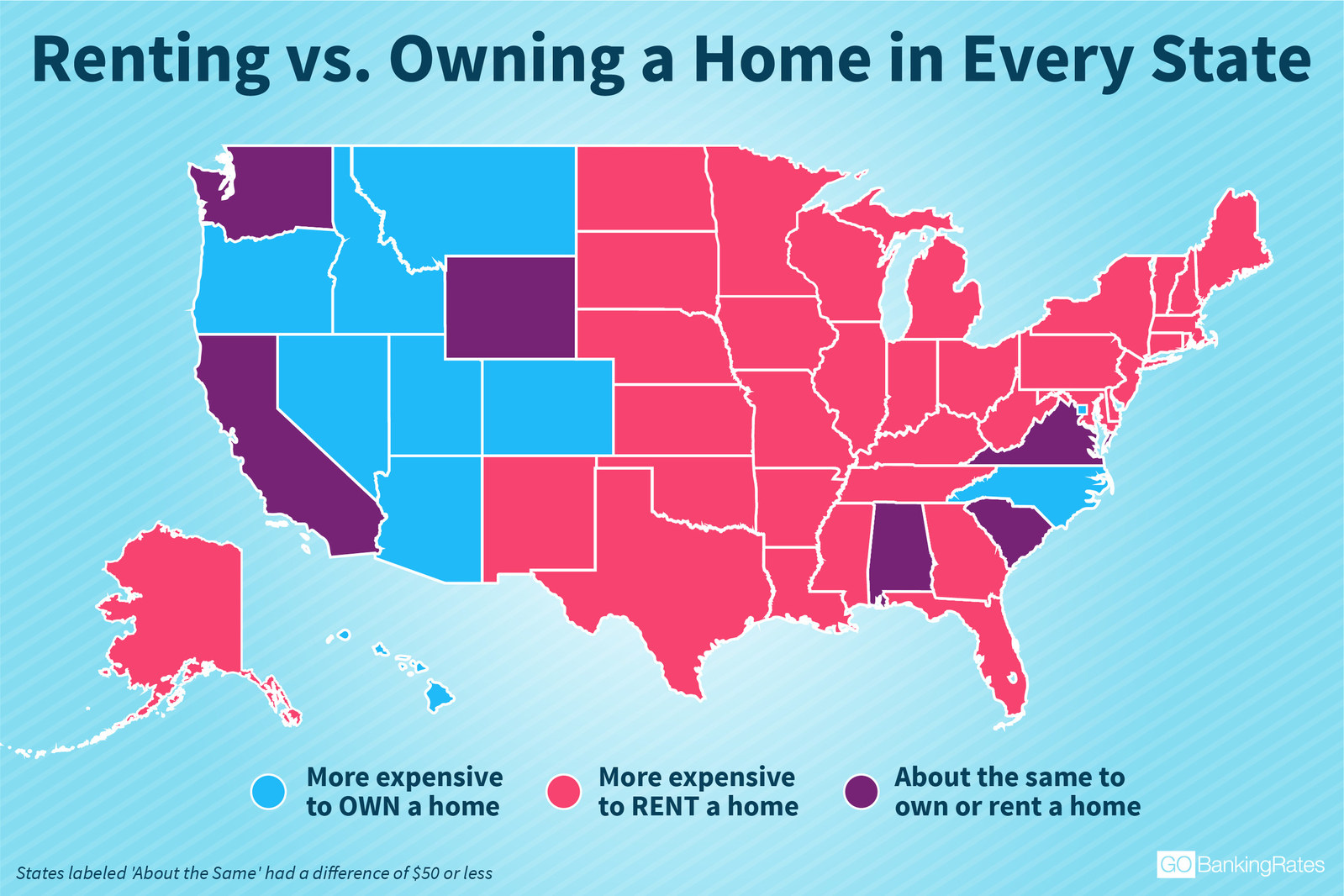
Buying a home, however, is still better than renting one in most states—35, to be exact, according to a recent study by GOBankingRates.

Analysts for GOBankingRates factored in recent median monthly home price and rent data by state, as well as mortgage rates—gathered by Zillow—to determine levels of affordability. The study assumed a 20 percent down payment on a 30-year, fixed-rate mortgage, and took into account homeowners insurance costs and property taxes.

Buying is significantly more affordable than renting in Alaska, Illinois, Maryland, New Jersey and New York, the study shows, with New Jersey residents saving $566 a month by owning—the highest yield of all states.

In six states, the gap between buying and renting is so slim that neither is substantially more affordable than the other: Alabama, California, South Carolina, Virginia, Washington and Wyoming.

The 35 states where buying is more affordable than renting are (in alphabetical order): Alaska; Arkansas; Connecticut; Delaware; Florida; Georgia; Illinois; Indiana; Iowa; Kansas; Kentucky; Louisiana; Maine; Maryland; Massachusetts; Michigan; Minnesota; Mississippi; Missouri; Nebraska; New Hampshire; New Jersey; New Mexico; New York; North Dakota; Ohio; Oklahoma; Pennsylvania; Rhode Island; South Dakota; Tennessee; Texas; Vermont; West Virginia; and Wisconsin.

View owning and renting costs by state.

Source: GOBankingRates

For the latest real estate news and trends, bookmark RISMedia.com.

The post Study: Buying Is Still Better Than Renting in Most States appeared first on RISMedia.

…read more

From:: Real Estate News

Pluristem stock rises 2.5% on mid-stage clinical trial results

Pluristem Therapeutics Inc. shares surged 2.5% to $1.21 in extremely heavy afternoon trade Wednesday after the company released new data from a clinical trial. The results, from a phase 2-equivalent clinical trial, focused on 12 primates and found that those primates had faster recovery in their white blood cell and platelet counts than a control group. This suggests that Pluristem’s PLX-R18 therapy, intended as a treatment for a radiation syndrome, could possibly be used for bone marrow deficiencies too, the company said. The study also strengthened the therapy’s safety profile, suggesting it could be used in disaster scenarios on those affected without having to confirm that they have the radiation syndrome, Pluristem said. Pluristem shares have dropped 16% over the last three months, compared with a 3.8% rise in the S&P 500 .

Market Pulse Stories are Rapid-fire, short news bursts on stocks and markets as they move. Visit MarketWatch.com for more information on this news.

…read more

From:: Stock Market News

House Votes to Repeal Arbitration Rule

Legislation to repeal a recently enacted rule that prohibits mandatory arbitration made it through the House this week.

On Tuesday, the House voted 231 to 190 to repeal the Consumer Financial Protection Bureau’s new arbitration rule.

According to proponents of mandatory arbitration, class-action suits reward lawyers more than they do consumers.


…read more

From:: Financing

Wall Street’s ‘fear gauge’ posts lowest intraday level in its history

The CBOE Volatility index briefly dropped to its lowest reading ever Wednesday following the conclusion of the Federal Reserve’s July policy meeting. The VIX dropped to as low as 8.84, its lowest reading since CBOE started publishing real-time data in the early 1990s, according to FactSet data. The decline for VIX accelerated after an updated policy statement from the Federal Reserve, released Wednesday afternoon, indicated that it would start to unwind its $4.5 trillion asset portfolio “relatively soon” and also signaled that it was focused on stubbornly low inflation. At last check, the VIX was down 1.2% at 9.32. Previously, the VIX had hit a low of 9.04 on Tuesday, and is down nearly 34% year to date.

Market Pulse Stories are Rapid-fire, short news bursts on stocks and markets as they move. Visit MarketWatch.com for more information on this news.

…read more

From:: Stock Market News

CMBS Storm Could Begin to Subside

Delinquency on loans included in commercial mortgage-backed securities continued to deteriorate, though conditions could soon begin to improve.

Securitized commercial real estate loans that were at least 30 days past due accounted for 3.19 percent of all CMBS loans outstanding as of June 30.

Last month’s level of delinquency worked out to the highest rate since December 2015, when the 30-day rate was previously reported at 3.43 percent.


…read more

From:: Financing

Oil prices settle at a roughly 2-month high

Oil prices settled at their highest level in about two months on Wednesday after U.S. government figures showed that crude supplies fell for a fourth week in a row. Prices have also found support from promises of cut backs in exports from some members of the Organization of the Petroleum Exporting Countries, concerns about Venezuelan oil supplies and signs of a possible slowdown in U.S. crude production. September WTI crude rose 86 cents, or 1.8%, to settle $48.75 a barrel on the New York Mercantile Exchange. That was the highest finish for a most-active contract since May 30, according to FactSet data.

Market Pulse Stories are Rapid-fire, short news bursts on stocks and markets as they move. Visit MarketWatch.com for more information on this news.

…read more

From:: Stock Market News

Dollar turns negative after Fed statement

The U.S. dollar pivoted lower on Wednesday after the Federal Reserve said it would begin winding down its bond holdings “relatively soon.” The central bank left rates unchanged as expected but the tone of the updated policy remarks might imply to investors that it is taking a go-it-slow approach, bearish for the buck. The U.S. dollar index traded at 94.05, in slightly negative territory, and off a high of 94.29 that had been hit earlier in the session. It saw a particular dip against the euro , which traded at $1.1688 from $1.1649 late Tuesday. Prior to the Fed statement, it had traded around $1.1630. Against the Japanese yen , the dollar changed hands at ¥111.74, compared with ¥112.13 prior to the announcement, and compared with ¥111.90 late Tuesday.

Market Pulse Stories are Rapid-fire, short news bursts on stocks and markets as they move. Visit MarketWatch.com for more information on this news.

…read more

From:: Stock Market News

New Home Sales Accelerate, West Leads

Newly constructed residential properties sold last month at an annual rate that was better than both one month earlier and one year earlier. The West led.

New single-family home sales numbered 55,000 during June, a minor decline of 2,000 units compared to the downwardly revised level for the preceding month.

Still, new residential home sales moved up by five thousand units versus the downwardly revised level for the same month during the preceding year.


…read more

From:: Financing