GoDaddy kicks off neo-Nazi site for violating terms of service

The neo-Nazi website Daily Stormer has been kicked off by its web hosting company, GoDaddy Inc. announced in a tweet Sunday night. GoDaddy , the world’s largest internet domain registrar with 17 million customers, said: “We informed The Daily Stormer that they have 24 hours to move the domain to another provider, as they have violated our terms of service.” The move apparently came in response to a Daily Stormer article demeaning Heather Heyer, a counter-protester killed when an alleged white supremacist drove into a crowd in Charlottesville, Va., on Saturday, injuring 19 others.

Market Pulse Stories are Rapid-fire, short news bursts on stocks and markets as they move. Visit MarketWatch.com for more information on this news.

…read more

From:: Stock Market News

Monday Morning Cup of Coffee: New Mexico warns of scammers pretending to be Nationstar

Borrowers and lenders, here is your warning! Reports of mortgage scams and financial hackers keep making it to HousingWire’s headlines. The latest attack involves well-known mortgage company Nationstar. In other news, Wells Fargo is in the headlines again. This time the mega bank is being accused of ripping off vulnerable mom-and-pop businesses. Details on all of this and more inside. …read more

From:: Real Estate Wire

At least 17 killed in attack on restaurant in Burkina Faso

At least 17 people were killed Sunday night in an attack by suspected Islamic extremists on a restaurant in Ouagadougou, the capital of Burkina Faso. Communication Minister Remi Dandjinou said another eight people were wounded in the attack on a Turkish restaurant. He said the victims were from various nationalities, and included at least one French citizen, according to the Associated Press. Gunshots were reported in the area hours after the initial attack. In 2016, an attack at a cafe in the West African country’s capital killed 30 people.

Market Pulse Stories are Rapid-fire, short news bursts on stocks and markets as they move. Visit MarketWatch.com for more information on this news.

…read more

From:: Stock Market News

Gap Slims Between Low- and High-Income Homeownership Rate

By Susanne Dwyer

Individuals with low incomes have historically struggled to become homeowners, cut off from the opportunity to not only build wealth through equity, but also establish an appreciating, long-term asset. New research now shows the homeownership rate in the lowest income tier is catching up to that of high-earners, edging closer since the onset of the recovery.

According to a study by Trulia, the homeownership rate of high-income households is 2.3 times the rate of low-income households: 77 percent versus 34.9 percent. The disparity, however, has thinned since 2012, when the homeownership rate of high-income households was 2.4 times higher than that of low-income households. The trend largely follows past housing cycles, with the gap narrowing during upswings and widening during downturns.

The study demonstrates the margin is more pronounced in major metropolitan areas, where the homeownership rate of high-income households is 79.3 percent, compared to the homeownership rate of low-income households at 27.9 percent—a 2.8 times difference. Some cities have a 4.4 times variance. The starkest inequalities tend to be where—among several indicators—households change homes more often and incomes are most disproportionate, such as Los Angeles, New Haven, Conn., and New York.

There is also a link between home values and the rate gap, the study illustrates, with the former closing as values become more evenly dispersed throughout a metro area (i.e., low-income households have a better chance of buying a home within their means when there is a higher variation in values).

Many other factors play a part in housing inequality, including the average age of a city’s population and homeownership tenure—and, as such, low-income households have improved homeownership rates depending on location, the study shows. Low-income households are more likely to own, for instance, in Daytona Beach, Fla., Long Island, N.Y., and Troy, Mich., where the homeownership rate of high-income households is just 2 times that of low-income households.

While little can be done about the demographic-based causes of the rate gap (e.g., age of population), study author Felipe Chacón, housing economist for Trulia, notes the potential for policy implementations to address the other issues driving inequality:

While demographic factors in some metros, such as a younger than average population, may be fueling unequal housing outcomes, along with a national trend that has been pointing to a gradually widening gap, there still seems to be plenty of opportunity for changes to local housing policy that could move the needle in a favorable wave for low-income groups.

For more information, please visit www.trulia.com.

Suzanne De Vita is RISMedia’s online news editor. Email her your real estate news ideas at sdevita@rismedia.com.

For the latest real estate news and trends, bookmark RISMedia.com.

The post Gap Slims Between Low- and High-Income Homeownership Rate appeared first on RISMedia.

…read more

From:: Finance and Economy

Gap Slims Between Low- and High-Income Homeownership Rate

By Susanne Dwyer

Individuals with low incomes have historically struggled to become homeowners, cut off from the opportunity to not only build wealth through equity, but also establish an appreciating, long-term asset. New research now shows the homeownership rate in the lowest income tier is catching up to that of high-earners, edging closer since the onset of the recovery.

According to a study by Trulia, the homeownership rate of high-income households is 2.3 times the rate of low-income households: 77 percent versus 34.9 percent. The disparity, however, has thinned since 2012, when the homeownership rate of high-income households was 2.4 times higher than that of low-income households. The trend largely follows past housing cycles, with the gap narrowing during upswings and widening during downturns.

The study demonstrates the margin is more pronounced in major metropolitan areas, where the homeownership rate of high-income households is 79.3 percent, compared to the homeownership rate of low-income households at 27.9 percent—a 2.8 times difference. Some cities have a 4.4 times variance. The starkest inequalities tend to be where—among several indicators—households change homes more often and incomes are most disproportionate, such as Los Angeles, New Haven, Conn., and New York.

There is also a link between home values and the rate gap, the study illustrates, with the former closing as values become more evenly dispersed throughout a metro area (i.e., low-income households have a better chance of buying a home within their means when there is a higher variation in values).

Many other factors play a part in housing inequality, including the average age of a city’s population and homeownership tenure—and, as such, low-income households have improved homeownership rates depending on location, the study shows. Low-income households are more likely to own, for instance, in Daytona Beach, Fla., Long Island, N.Y., and Troy, Mich., where the homeownership rate of high-income households is just 2 times that of low-income households.

While little can be done about the demographic-based causes of the rate gap (e.g., age of population), study author Felipe Chacón, housing economist for Trulia, notes the potential for policy implementations to address the other issues driving inequality:

While demographic factors in some metros, such as a younger than average population, may be fueling unequal housing outcomes, along with a national trend that has been pointing to a gradually widening gap, there still seems to be plenty of opportunity for changes to local housing policy that could move the needle in a favorable wave for low-income groups.

For more information, please visit www.trulia.com.

Suzanne De Vita is RISMedia’s online news editor. Email her your real estate news ideas at sdevita@rismedia.com.

For the latest real estate news and trends, bookmark RISMedia.com.

The post Gap Slims Between Low- and High-Income Homeownership Rate appeared first on RISMedia.

…read more

From:: Real Estate News

The EB-5 Visa Program: Balancing Risk and Opportunity

By Susanne Dwyer

For a quarter-century, the EB-5 visa program has helped finance economic development projects across America, sparking job growth and business investment in cities, suburbs and rural regions throughout the U.S.—all at no cost to the taxpayer. EB-5-funded projects span a diverse range of regions and industries, from charter schools in Utah and manufacturing plants in South Carolina to mixed-use commercial property in downtown Washington, D.C.

The Brookings Institute estimates the EB-5 program has generated at least $5 billion in investment and directly created at least 85,500 American jobs since its creation, with most of these gains realized since 2010.

In addition to direct jobs, the EB-5 program has supported the creation of countless other indirect jobs in communities surrounding EB-5 projects. For example, a manufacturing plant built with EB-5 investment may create new growth opportunities for parts suppliers, while a new EB-5-funded hotel can generate more demand for local restaurants and retail shops. That’s a hefty economic punch for a program that represents just 2.9 percent of all employment-based visas.

Regulated by the U.S. Department of Homeland Security, the EB-5 program provides a path to citizenship to foreign investor-entrepreneurs that can approve up to 10,000 visas each year. The initial application requires proof of investment in a qualified project, evidence of an investment of at least $500,000 and the creation of at least 10 U.S. jobs. EB-5 applicants undergo two rounds of extensive background checks administered by the Department of Homeland Security and Department of State. This screening process is more robust than any other employment-based visa program, and pays for itself through fees.

Most EB-5 applications come through one of the approved regional centers, which market the program abroad, pool investment and often facilitate the development of EB-5 projects. In the past 10 years, the EB-5 Regional Center Program has increased the number of EB-5 applications and supported the development of projects, substantially increasing the number of visas awarded and jobs created by the program.

The EB-5 Regional Center Program has been reauthorized every three years since its creation in 1992 by broad bipartisan margins. It is up for reauthorization again in September 2017.

The National Association of REALTORS® supports legislation to reauthorize the EB-5 Regional Center Program before it expires. NAR also supports reforms to the EB-5 program that would address national security concerns, deter fraud and put Americans to work. If not reauthorized by September 30, an estimated 6.8 billion in foreign investment dollars and as many as 130,000 American jobs will be lost.

Congress has considered reforming the EB-5 program for several years, but has never been able to enact a reform bill, in part because of differences on three key issues:

  1. How to define rural and high unemployment areas
  2. Whether the EB-5 program should have special visa allocations for projects in rural and distressed urban areas
  3. What the minimum investment amount should be

This year may finally see enactment of an EB-5 reform bill. Areas to be reformed could include:

  • Permanently authorize the EB-5 Regional Center Program
  • Require regional centers to disclose financial statements related to EB-5 projects
  • Institute …read more

    From:: Real Estate News

Want to Save for a Down Payment? Skip the Pre-Wedding Shenanigans

By Susanne Dwyer

Zillow_Bachelor_Party

Would-be homeowners can easily plunk down savings for a home—if they forgo their friends’ one last hurrah before the big day.

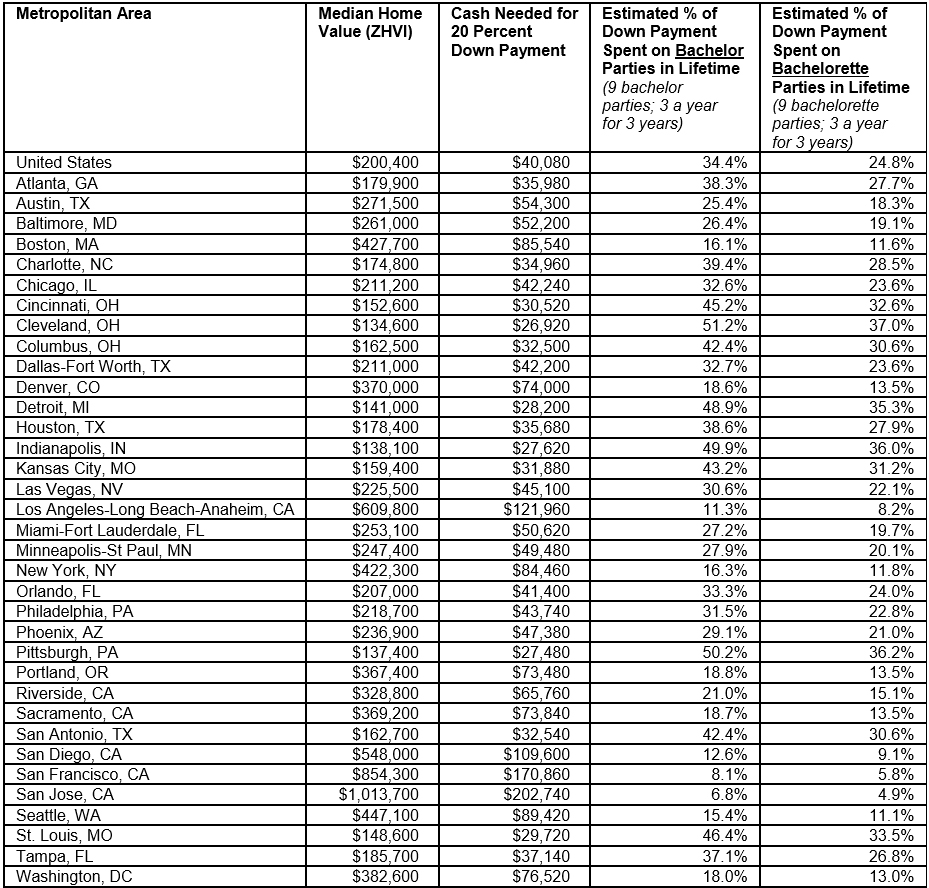
A recent report by Zillow reveals the cost of destination bachelor or bachelorette parties can equal up to one-third of a down payment on a median-priced home. With attendees spending an average $1,106 (for destination bachelorette parties) and $1,532 (for destination bachelor parties), according to The Knot, partaking in just nine pre-marriage celebrations—or three each year for three years—would total 34 percent, or $13,788, of a 20 percent down payment on a median-priced home.

Without question, the amount of parties needed to rack up one-third of a down payment varies by market:

Bachelor and bachelorette getaways are just one of several stereotypically “millennial” spending choices called into question as of late. Earlier this year, one real estate developer singled out avocados, telling Australia’s “60 Minutes”: “When I was buying my first home, I wasn’t buying smashed avocado for 19 bucks and four coffees at $4 each.”

“Buying a home is one of the most expensive purchases someone will ever make, and for most first-time buyers, that means years of saving money to afford a down payment,” says Jeremy Wacksman, CMO at Zillow. “Attending your friends’ bachelor or bachelorette parties can be a trip of a lifetime. While everyone’s budget and priorities are different, big-ticket expenses like vacations can add up surprisingly quickly—a lot faster than a $19 avocado toast.”

For more information, please visit www.zillow.com.

Suzanne De Vita is RISMedia’s online news editor. Email her your real estate news ideas at sdevita@rismedia.com.

For the latest real estate news and trends, bookmark RISMedia.com.

The post Want to Save for a Down Payment? Skip the Pre-Wedding Shenanigans appeared first on RISMedia.

…read more

From:: Real Estate News

NAHB: Affordability Turns Downward in Q2

By Susanne Dwyer

Housing affordability took a turn downward in the second quarter of 2017, as home prices and mortgage rates moved opposite, according to the latest National Association of Home Builders (NAHB)/Wells Fargo Housing Opportunity Index (HOI). Approximately 59 percent of homes sold in the second quarter were affordable based on the national median income, $68,000, a share down from roughly 60 percent in the first quarter. The national median home price in the second quarter was $256,000, weighed against the average mortgage rate, 4.08 percent.

“The job market continues to gain steam and this is boosting housing demand,” said Robert Dietz, chief economist of the NAHB, in a statement. “Meanwhile, growing incomes and attractive mortgage rates are helping to keep housing affordable by partially offsetting ongoing home price appreciation.”

The most affordable major metropolitan areas in the second quarter, based on local median home price and median income, were (in order): Youngstown-Warren-Boardman, Ohio-Pa. Syracuse, N.Y.; Dayton, Ohio; Buffalo-Cheektowaga-Niagara Falls, N.Y.; and Scranton-Wilkes Barre-Hazleton, Pa., according to the Index.

“While builder confidence remains solid and sales and starts are running at a healthy clip above last year’s levels, housing continues to confront persistent headwinds,” said Granger MacDonald, chairman of the NAHB. “Rising material prices, particularly lumber, along with chronic shortages of buildable lots and skilled labor are putting upward pressure on home prices and impeding a more robust housing recovery.”

“Home prices will continue to rise as inventory remains tight,” Dietz said. “NAHB expects the housing market will continue to make gradual gains in 2017.”

Source: National Association of Home Builders (NAHB)

For the latest real estate news and trends, bookmark RISMedia.com.

The post NAHB: Affordability Turns Downward in Q2 appeared first on RISMedia.

…read more

From:: Finance and Economy

Crowd rammed by car after Charlottesville, Va., nationalist rally’s cancellation: reports

One or more cars reportedly plowed into a crowd of people near the site of Saturday’s broken-up nationalist rally in Charlottesville, Va. An NBC reporter said six ambulances had arrived on the scene and later departed. Broadcast reports indicated six to nine people, or more, were victims of the crash. There were “multiple injuries,” according to the local Daily Progress newspaper. A vehicle appeared to have struck a group of counterdemonstrators, according to a report by MSNBC, which hastened to note that it could not be determined whether the incident was in any manner intentional. The car that initially plowed into the group departed the scene, with one or more police cars later in pursuit, according to an MSNBC correspondent on the scene.

Market Pulse Stories are Rapid-fire, short news bursts on stocks and markets as they move. Visit MarketWatch.com for more information on this news.

…read more

From:: Stock Market News

Are Relocation Professionals Robot-Proof?

By Susanne Dwyer

Ever wonder how artificial intelligence would affect the corporate relocation industry? Could robots ever take over?

Clearly, there is expanding reliance on technology applications, especially to track and report data and manage administration processes. But among the tech tools, many corporate programs feature personalized consultation that Relocation Management Company (RMC) counselors provide to assignees throughout the process. The counselor or consultant coordinates employer-provided services and facilitates the move to the new location. Besides relocation subject expertise and service delivery, counselor performance is assessed on various interpersonal skills, including knowledge and explanation of mobility policies, responsiveness to assignees’ needs and problem-solving ability.

The job of a corporate relocation counselor can be challenging for many reasons. First, each assignee’s situation tends to differ, so no two relocations are exactly alike. Also, counselors interact with individuals and families during a typically high-stress period—uprooting and moving one’s residence while starting a new job assignment. Counselors can handle 50 or more transfers at a time, although caseload depends on policy/program complexity and whether assignees are renters or homeowners. To succeed in this environment, counselors’ skillsets must include strong interpersonal and critical thinking skills.

While relocation department staff skill requirements are not identical, there is much similarity. In addition to local real estate expertise, relocation department staff must also possess the same high-service mentality and interpersonal qualities as RMC consultants. Other skills that similarly benefit both roles include critical thinking, discerning judgment and creativity—all needed to handle diverse situations arising during home marketing, negotiation and home search processes. These qualities and a desire to help assignees and families navigate the often-stressful relocation process are vital whether in a corporate or real estate brokerage setting.

So, could we ever see automated relocation professionals? Probably not soon. Research indicates it won’t be easy for artificial intelligence to duplicate jobs that depend on social and other ‘humanistic’ skills.

More Consultative – Less Robotic
One of five main themes about tech age job training according to “The Future of Jobs and Jobs Training” (Pew Research Center, 2017), is that “Learners must cultivate 21st century skills, capabilities and attributes” to protect their jobs from robots. The research further explains that “Tough-to-teach intangibles such as emotional intelligence, curiosity, creativity, adaptability, resilience and critical thinking will be most highly valued.” Add empathy, and these are many of the personal characteristics that RMC consultants and relocation department staff use daily to successfully interact with assignees on the phone and in the field.

Other research on this topic indicate similar findings. According to “The Future of Employment: How Susceptible are Jobs to Computerisation?” a paper by Carl Benedikt Frey and Michael Osborne, University of Oxford, telemarketing jobs are most likely to be done by a robot. No surprise there. The study also found that mental health and social services jobs had much less chance of being automated, because they ranked high in “…cleverness, negotiation and helping others.”

Not surprisingly, the relocation industry draws many with backgrounds and work experience in education/teaching and the social sciences. Relocation department personnel having these backgrounds or interests …read more

From:: Real Estate News