
Quantifying Gentrification: Where ‘Cool’ and Affordable Is Still Possible

By Susanne Dwyer

HouseCanary_1

Despite beards and man buns being on their way out, skinny jeans fading, and bread pudding in mason jars making way for gelato, the global hipster movement has left a mark on American lifestyle. Across the country, demand continues for neighborhoods where you can bike to coffee, pick up peaches at a farmer’s market, or get some culture at a local gallery or art walk.

The U.S. has seen a decisive resurgence in urban living, driving people in their 20s and 30s to pick cool, walkable areas over remote cul-de-sacs. What does this mean for investors looking to benefit from the demand? Mike Greene, head of Partner Development at HouseCanary, and I pulled on HouseCanary’s Home Price Indices data to find out.

A good accountant will tell you that you shouldn’t spend more than 30 percent of your income on your home. Ten years into the current housing cycle, however, there are few places on the coasts with 30 percent affordability (defined as percentage of household income consumed by a house payment).

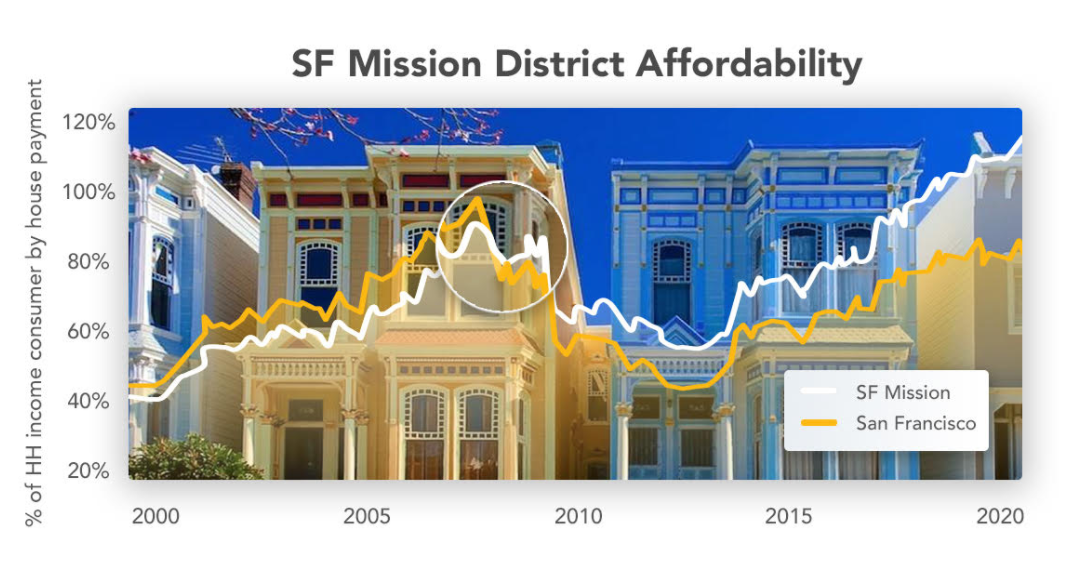
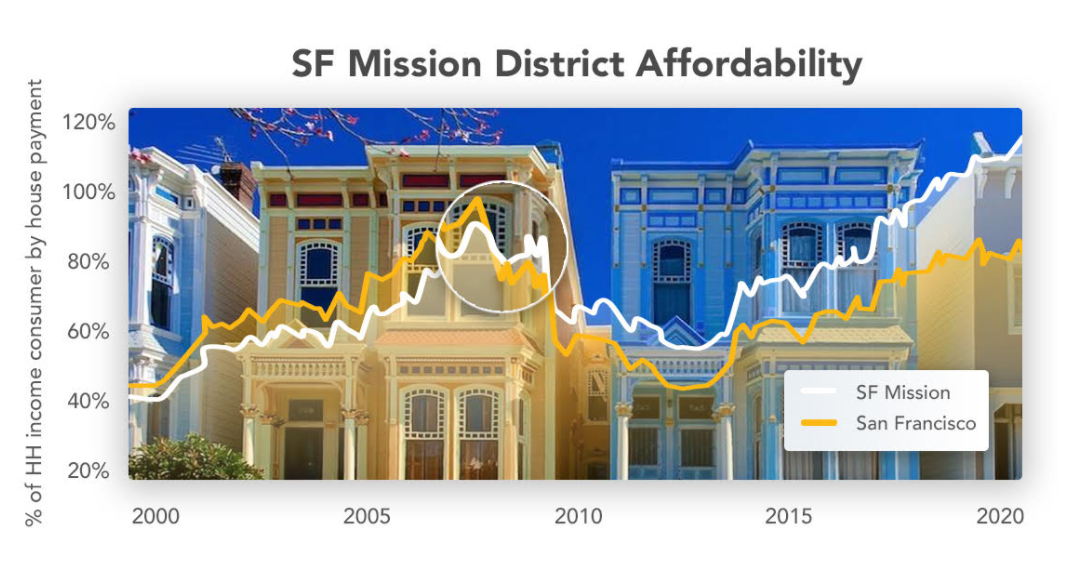
The popular Mission District in San Francisco hasn’t seen 40 percent since the year 2000, when it was gritty, unsafe and actually more affordable than the rest of the city. A trickle of affluent residents turned into a flood in 2008, and affordability flipped. Since then, the gap has widened, with 100 percent affordability (completely unaffordable) in the Mission versus 75 percent in the broader San Francisco metropolitan statistical area (MSA).

We’ll likely observe a similar dynamic in other U.S. neighborhoods, and investors can use the local affordability trend line to zero in on properties with upside.

On the opposite side of Manhattan Island from hipster (and already unaffordable) Williamsburg lies Hoboken, N.J. Nearly 50 percent of its population is between 20 and 34 years old—and it’s not just because of its proximity to Manhattan. Packed into Hoboken’s mere square mile are venues like Northern Soul Bar, Garden Street Farmers Market, Arts & Music Festival and Hoboken’s Food & Culture Tour—all examples of a growing urban vibe.

More importantly, Hoboken’s affordability is at a mere 35 percent and still comfortably below that of the N.Y.-N.J.-Long Island MSA’s 40 percent—and clearly below that of Manhattan itself, which ranges from 60 percent to more than 100 percent.

Compiled into a HouseCanary e-book, we looked at the top 19 hipster enclaves identified by CBS News and found a number of other gems.

The Clarendon neighborhood in Arlington, Va. is one of them, with its Home Price Index accelerating rapidly versus that of its broader MSA—and its affordability chart looking not unlike that of San Francisco’s Mission.

If you’re data geeks like Mike and I, you’ll enjoy seeing how HouseCanary’s Home Price Indices are helping some of the biggest real estate investors decide where to buy or sell next. We certainly enjoyed quantifying where the cool kids are moving—and making sense of what it means for those who’d like to follow their nose for cool.

A version of this article originally appeared …read more

From:: Real Estate News

Why Bigger Isn’t Always Better

By Susanne Dwyer

The National Association of REALTORS® reported that existing-home sales finished 2016 at 5.45 million, up from 2015 (5.25 million) and the highest since 2006 (6.48 million). This was certainly good news for the health of our industry, but creates a math problem for those keeping score on the leading real estate portals. How? Let’s run the numbers.

With about 5.5 million homes sold in a year, that means there are 11 million sides to a completed transaction. If we assume that there might be two partners on each side of the home-buying and -selling process, then we have a total of 22 million actual participants in a completed existing-home transaction—in a full year. That begs the question: What are 180 million unique users doing on the largest real estate portal brand’s websites—in a month? We can safely draw the conclusion that most of them aren’t buying and selling a home this month, or next month, or even this year. Trying to find an actual consumer with an intent to buy or sell a home in a sea of more than 100 million users per month can feel like looking for a needle in a haystack…and might yield diminishing returns for brokers and agents who advertise on these sites.

Which is why at Homes.com, we’re not focused on generating a bigger and bigger audience; we’re focused on delivering the right audience—a transaction-ready consumer for faster conversion to a closed transaction. Through the second quarter of 2017, we’ve averaged around 9 million unique visitors per month, a number that aligns well with the actual number of active homebuyers and sellers in a month. And these visitors are actively looking to buy, rent and sell homes, not browsing home value estimates or looking at home design styles. Over 90 percent of pageviews on Homes.com occur in our Homes for Sale or Rent sections.

One key to the high-quality traffic on Homes.com is how we source our users. We don’t spend money to advertise on broadcast and cable television, where the majority of viewers aren’t currently in the market to buy or sell a home. Nearly 90 percent of our traffic is organic—either users typing Homes.com directly into their browser or finding Homes.com via natural search results on Google or Bing, often searching “homes for sale” in a particular city, zip code or neighborhood.

Another key to quality traffic is providing an outstanding user experience. The most important component of the real estate search experience is the quality of the property data. Local MLSs are the best source of local listing data, which is why we work closely with local brokers and MLS executives to earn the right to display the content you work so hard to generate. We know we aren’t entitled to your data, and that we must earn your trust by doing what’s right. That’s why, for example, listing agents always receive all leads from their listings on Homes.com, whether they’re a paid advertiser with us or not. I encourage you to ask your other …read more

From:: Real Estate News

For Sale: Former Social Club of George Washington

By Susanne Dwyer

George_Washington_Social_Club_2-6

Editor’s Note: This was originally published on RISMedia’s blog, Housecall. See what else is cookin’ now at blog.rismedia.com:

Would you like to rub elbows with George Washington? Well, you can’t, but you can live in a space his elbows once rubbed. Located at 555 Washington Street in Alexandria, Va., a former social club that hosted the likes of the late great leader, is now on the market. The original event space was built in the 1700s, then turned into a restaurant, and finally renovated into a sweet, sunny condo in 2008.

Full of rich details, this three-bedroom, three-bathroom unit perfectly encapsulates Southern charm. Spanning 2,202 square feet, the Colonial unit has exposed brick flooring and accents, a chef’s kitchen, a two-car garage, wide, sun-filled rooms, and a private patio alcove with a cozy fireplace perfect for entertaining.

Listed by: Sue Goodhart, The Goodhart Group at McEnearney Associates
Listed for: $1,099,000

Image Credit: Shoot & Showcase

Zoe Eisenberg is RISMedia’s senior content editor. Email her your real estate news ideas at zoe@rismedia.com.

For the latest real estate news and trends, bookmark RISMedia.com.

The post For Sale: Former Social Club of George Washington appeared first on RISMedia.

…read more

From:: Real Estate News

Prince William and Kate are expecting their third baby

The Duchess of Cambridge, Kate Middleton, is pregnant with her third child with husband Prince William, Kensington Palace said on Monday. As with her first two children — Prince George and Princess Charlotte — Kate is suffering from hyperemises gravidarum, or severe morning sickness, and is being cared for at Kensington Palace, according to a statement. The new baby will be fifth in line to the British throne, pushing Prince William’s younger brother, Harry, down the line of succession. Prince Charles, Queen Elizabeth II’s oldest son, is currently No. 1 in the succession line.

Market Pulse Stories are Rapid-fire, short news bursts on stocks and markets as they move. Visit MarketWatch.com for more information on this news.

…read more

From:: Stock Market News

Man dies at Burning Man after running into flames

A 41-year-old man died of his burns after running into a massive fire at the Burning Man festival in Nevada’s Black Rock Desert. Authorities said Aaron Joel Mitchell broke through a security perimeter Saturday night as a 40-foot effigy was set alight, and ran into the flames. Firefighters pulled him out, but he died Sunday morning after being airlifted to a burn center in Davis, Calif. Authorities said about 50,000 people were watching the effigy burn, which typically caps off the weeklong celebration. In a statement, the Burning Man organization said it canceled other burns scheduled for Sunday, but will hold the traditional Temple burn Sunday night. “Now is a time for closeness, contact and community,” the organization said, and trauma counselors have been made available. “Trauma needs processing. Promote calls, hugs, self-care, check-ins, and sleep.” The festival has been held the the remote Nevada desert since 1990, and draws many from the arts, entertainment and tech communities.

Market Pulse Stories are Rapid-fire, short news bursts on stocks and markets as they move. Visit MarketWatch.com for more information on this news.

…read more

From:: Stock Market News

Trump will end DACA, with 6-month enforcement delay: report

President Donald Trump has decided to end the Deferred Action for Childhood Arrivals program, according to a report late Sunday by Politico. The action would result in the deportation of nearly 800,000 children of undocumented immigrants, known as “Dreamers,” and is likely to ignite another political firestorm for the Trump administration. DACA has significant bipartisan support in Congress, and a number of top Republicans have warned against its repeal. According to Politico, enforcement will be delayed for six months, which could give Congress enough time to come up with a replacement plan. Ending DACA was a campaign promise of Trump, and the White House said last week an official announcement was expected Tuesday. A number of executives from Fortune 500 companies, including Apple Inc. CEO Tim Cook, have signed a letter of support for Dreamers, calling them vital to America’s future and warning of the economic repercussions. “Our economy would lose $460.3 billion from the national GDP and $24.6 billion in Social Security and Medicare tax contributions,” the group said in an open letter Thursday.

Market Pulse Stories are Rapid-fire, short news bursts on stocks and markets as they move. Visit MarketWatch.com for more information on this news.

…read more

From:: Stock Market News

Consumer Confidence Keeps Improving

By Susanne Dwyer

Consumer confidence kept improving in August, posting a 122.9 reading in the latest Consumer Confidence Index® from The Conference Board. The Expectations reading of the Index rose to 104.0, while the Present Situation reading rose to 151.2. July’s reading was 120.0.

“Consumer confidence increased in August following a moderate improvement in July,” said Lynn Franco, director of Economic Indicators at The Conference Board in a statement. “Consumers’ more buoyant assessment of present-day conditions was the primary driver of the boost in confidence, with the Present Situation Index continuing to hover at a 16-year high. Consumers’ short-term expectations were relatively flat, though still optimistic, suggesting that they do not anticipate an acceleration in the pace of economic activity in the months ahead.”

The percentage of consumers who believe business conditions are “good,” as defined by the Index, increased from 32.5 percent in July to 34.5 percent in August; the percentage of those who believe business conditions are “bad” decreased from 13.5 percent in July to 13.1 percent in August. The percentage of those who expect business conditions to improve decreased from 22.4 percent in July to 19.6 percent in August; the percentage of those who expect business conditions to worsen decreased from 8.4 percent in July to 7.3 percent in August.

The percentage of consumers who believe jobs are “plentiful” increased from 33.2 percent in July to 35.4 percent in August, according to the Index; the percentage of those who believe jobs are “hard to get” decreased from 18.7 percent in July to 17.3 percent in August. The percentage of those who expect more jobs in the coming months decreased from 18.5 percent in July to 17.1 percent in August; the percentage of those who expect less jobs in the coming months decreased from 13.2 percent in July to 13.0 percent in August.

The percentage of consumers who expect higher incomes increased from 20.0 percent in July to 20.9 percent in August; the percentage of those who expect a decrease increased from 9.5 percent in July to 7.8 percent in August.

Source: The Conference Board

For the latest real estate news and trends, bookmark RISMedia.com.

The post Consumer Confidence Keeps Improving appeared first on RISMedia.

…read more

From:: Real Estate News

Fannie, Freddie Suspend Evictions, Foreclosures in Harvey’s Wake

By Susanne Dwyer

Fannie Mae and Freddie Mac are enacting 90-day eviction and foreclosure suspensions for homeowners in federally-declared disaster zones impacted by Hurricane Harvey.

“Our thoughts are with the families in the path of this powerful and catastrophic storm,” says Carlos Perez, senior vice president and chief credit officer at Fannie Mae. “We continue to monitor the situation in the affected areas. The storm, while weakened, continues in many areas and it is simply too early to provide any data or assessment about the scale or scope of damage resulting from Hurricane Harvey. Preliminary assessments of actual damage at this point may be inaccurate and potentially misleading. We will continue to work with our single-family servicers to communicate our policies and ensure borrowers have access to the information and resources they need to help manage their housing challenges. We also continue to work with our Multifamily DUS® lenders and borrowers to determine appropriate actions to assist renters impacted by the storm.”

“We’re committed to ensuring that homeowners receive the mortgage assistance they need to overcome the devastating tragedy of Hurricane Harvey,” says Yvette Gilmore, vice president of Single-Family Servicer Performance Management at Freddie Mac. “Once they’re out of harm’s way, homeowners should contact their servicers—the company to which they send their monthly mortgage payments. They may be eligible for forbearance on mortgage payments for up to one year if their mortgage is owned or guaranteed by Freddie Mac.”

Fannie and Freddie announced earlier this week the option for servicers to grant forbearances to Harvey victims.

Sources: Fannie Mae, Freddie Mac

For the latest real estate news and trends, bookmark RISMedia.com.

The post Fannie, Freddie Suspend Evictions, Foreclosures in Harvey’s Wake appeared first on RISMedia.

…read more

From:: Finance and Economy

Fannie, Freddie Suspend Evictions, Foreclosures in Harvey’s Wake

By Susanne Dwyer

Fannie Mae and Freddie Mac are enacting 90-day eviction and foreclosure suspensions for homeowners in federally-declared disaster zones impacted by Hurricane Harvey.

“Our thoughts are with the families in the path of this powerful and catastrophic storm,” says Carlos Perez, senior vice president and chief credit officer at Fannie Mae. “We continue to monitor the situation in the affected areas. The storm, while weakened, continues in many areas and it is simply too early to provide any data or assessment about the scale or scope of damage resulting from Hurricane Harvey. Preliminary assessments of actual damage at this point may be inaccurate and potentially misleading. We will continue to work with our single-family servicers to communicate our policies and ensure borrowers have access to the information and resources they need to help manage their housing challenges. We also continue to work with our Multifamily DUS® lenders and borrowers to determine appropriate actions to assist renters impacted by the storm.”

“We’re committed to ensuring that homeowners receive the mortgage assistance they need to overcome the devastating tragedy of Hurricane Harvey,” says Yvette Gilmore, vice president of Single-Family Servicer Performance Management at Freddie Mac. “Once they’re out of harm’s way, homeowners should contact their servicers—the company to which they send their monthly mortgage payments. They may be eligible for forbearance on mortgage payments for up to one year if their mortgage is owned or guaranteed by Freddie Mac.”

Fannie and Freddie announced earlier this week the option for servicers to grant forbearances to Harvey victims.

Sources: Fannie Mae, Freddie Mac

For the latest real estate news and trends, bookmark RISMedia.com.

The post Fannie, Freddie Suspend Evictions, Foreclosures in Harvey’s Wake appeared first on RISMedia.

…read more

From:: Real Estate News

Multifamily Sector Posts Gains in Q2

By Susanne Dwyer

The multifamily housing market, which includes apartments and condominiums, posted gains in the second quarter of 2017, according to the latest National Association of Home Builders (NAHB) Multifamily Production Index (MPI). The Index rose eight points to 56. An above-50 reading indicates more builders have a positive outlook than a negative one.

“A return to a positive trend in the MPI is consistent with positive builder sentiment in other segments of the housing industry,” said Robert Dietz, chief economist of the NAHB, in a statement. “Multifamily demand remains solid, even as apartment construction comes off cycle highs as the multifamily market seeks a balance between supply and demand.”

The Index includes three measures: construction of low-rent units, market-rate units and for sale units (i.e., condos). All three rose in the second quarter, with construction of low-rent and market-rate units up five points to 53 and 60, respectively, and construction of for sale units up 14 points to 57—the highest in the Index since 2005.

“Multifamily developers continue to see strong demand in many parts of the country,” said Steven E. Lawson, and vice chairman of NAHB’s Multifamily Council, in a statement. “However, developers need to be careful to manage costs as prices of land, labor and some materials continue to rise.”

Source: National Association of Home Builders (NAHB)

For the latest real estate news and trends, bookmark RISMedia.com.

The post Multifamily Sector Posts Gains in Q2 appeared first on RISMedia.

…read more

From:: Finance and Economy