Dialog dives 14% after saying it could lose some Apple business

Shares in Dialog Semiconductor PLC dived 14% on Monday after the company acknowledged it eventually could lose some of Apple Inc.’s business. Dialog, which makes power management integrated circuits, said it “recognizes Apple has the resources and capability to internally design a PMIC and could potentially do so in the next few years.” The British chip maker that is listed in Germany also said in a news release that it “does not have reason to believe
its current expectations of 2018 Apple business would be impacted by such potential actions” and it continues to supply its largest customer
with PMICs across a range of platforms.

Market Pulse Stories are Rapid-fire, short news bursts on stocks and markets as they move. Visit MarketWatch.com for more information on this news.

…read more

From:: Stock Market News

Australian regulator to investigate Facebook, Google’s impact on local news

An Australian government regulator said Monday it will investigate Facebook Inc. and Alphabet Inc.’s Google to see if the tech giants’ platforms have unfairly disrupted the country’s media and advertising business. The government said it hopes to find the impact that social media and search engines are having on the overall news environment. “We will examine whether platforms are exercising market power in commercial dealings to the detriment of consumers, media content creators and advertisers,” Australian Competition and Consumer Commission Chairman Rod Sims said in a statement. As in the U.S., Australian newspapers have seen significant reductions in print ad revenue in recent years, and the government is concerned that digital platforms are hurting local journalism and media consumers. “Through our inquiry, the ACCC will look closely at the impact of digital platforms on the level of choice and quality of news and content being produced by Australian journalists,” Sims said.

Market Pulse Stories are Rapid-fire, short news bursts on stocks and markets as they move. Visit MarketWatch.com for more information on this news.

…read more

From:: Stock Market News

When Data Makes the Difference

By Susanne Dwyer

How HouseCanary Is Giving Agents a Competitive Edge

Editor’s Note: The following is the cover story in the December issue of RISMedia’s real estate magazine.

It’s no secret: The value of the real estate agent is under attack. With a slew of disruptors determined to diminish their role in the real estate transaction, it’s become incumbent upon agents to bolster their value proposition to the consumer with more service, more guidance, more information…whatever it takes to stand apart and make themselves an indispensable advisor in an increasingly competitive and crowded market.

That’s where data comes in. But while consumers seem to have access to all the real estate data they could possibly want these days, there are vast discrepancies in the quality of that data. Every real estate agent out there probably has at least one tale to tell of how an inaccurate home valuation bungled a deal. And that’s exactly what makes HouseCanary a game-changer.

Not only has the San Francisco-based firm redefined the practice of home valuation in terms of accuracy—with a median error of 2.5 percent and declining every month as the company’s algorithms process more data—it is helping real estate professionals set themselves apart with the burgeoning power of predictive analytics, elevating them from average real estate agent to invaluable financial advisor. By leveraging 40 years of U.S. home sales and a billion transactions to predict the direction of virtually every metro, zip code and block in the United States, HouseCanary can provide agents with branded, property-specific reports that depict how their client’s home value has increased, where the value of the home is headed, and which improvements will have the biggest impact on that value. Now, instead of the typical listing presentation, agents can explain—in precise detail—the “why” behind a home’s current and future value.

Co-founded by CEO Jeremy Sicklick and Chief of Research Chris Stroud in 2014 to help investors and lenders make better real estate decisions, HouseCanary created one of the most accurate forecasting models in the industry, then packaged it into easy-to-use software solutions for appraisers, brokers, investors and lenders, including Wall Street investors like Blackstone and the nation’s top three mortgage lenders; $64 million in venture capital funding from the likes of Eric Schmidt, chairman of Google parent Alphabet, former Commerce Secretary Penny Pritzker, and top venture capital firms helped solidify HouseCanary’s status as the real deal.

In 2016, HouseCanary made that same data available to real estate professionals—now, that same information lenders had been using to decide whether or not to extend a loan, could also be accessed by a real estate agent working on the front lines with the consumer. Imagine being able to sit down with clients and walk them through the exact financials of why they should make a particular offer—an offer based on real data and real numbers. Interactions like this cast the real estate agent in a whole new light.

“Innovative lenders and savvy loan originators are leveraging HouseCanary’s data to give their clients confidence in the home purchase decision they’re about …read more

From:: Real Estate News

Homeowners Spend Less, Renters Spend More

By Susanne Dwyer

Zillow_Rents_Q3

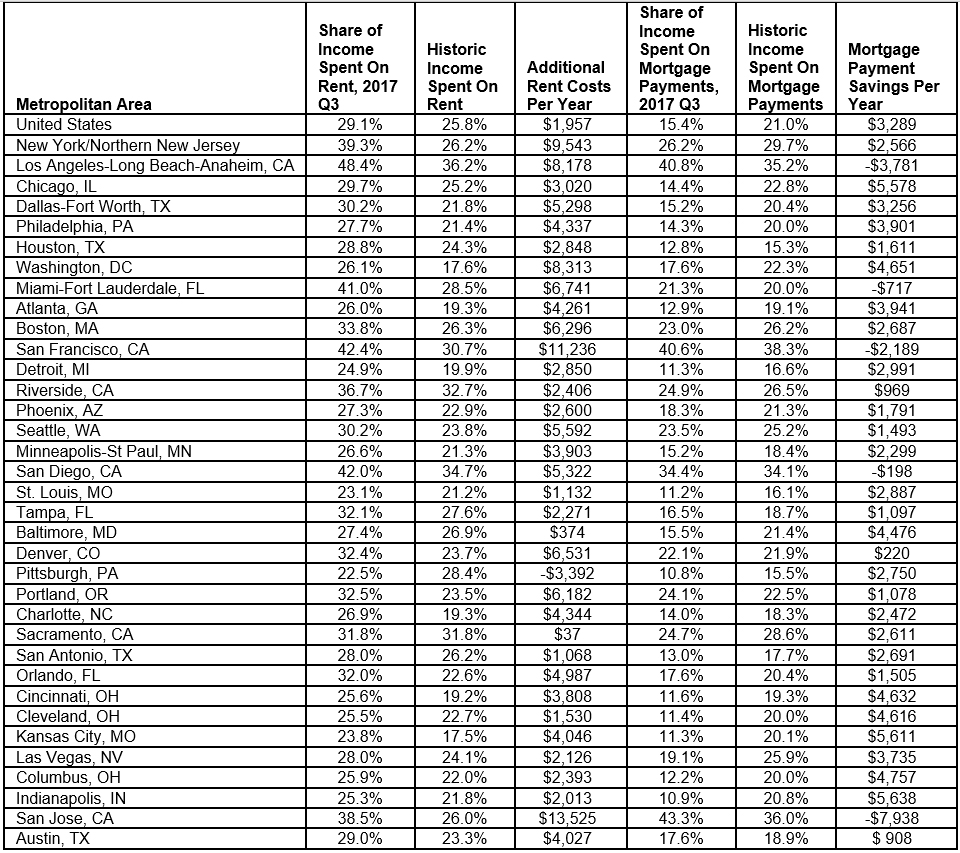
Incomes are not keeping pace with rents.

More earnings are needed for rent than in years past—now 29.1 percent of the median monthly income, versus the 25.8 percent needed prior to the recession, according to an analysis recently released by Zillow. The difference equals $1,957 more than if the share had stayed the same.

Homeowners, however, are not allocating more of their income to a mortgage, the analysis shows. A mortgage accounts for 15.4 percent of the median monthly income now, versus 21 percent prior to the recession—$3,289 in savings.

The discrepancy has implications for renters, says Dr. Svenja Gudell, chief economist at Zillow.

“In most markets, current renters are at a disadvantage compared to years past because paying the rent takes up a much larger share of their income than it did before,” Gudell says. “For many people, that can mean less cash to put toward paying off student debt, building an emergency fund, or saving for retirement. For those hoping to buy a home, it could be a significant part of their down payment. For parents, it could mean additional childcare or a family vacation. This is another example of how much worse rent affordability has gotten.”

For more information, please visit www.zillow.com.

Suzanne De Vita is RISMedia’s online news editor. Email her your real estate news ideas at sdevita@rismedia.com.

For the latest real estate news and trends, bookmark RISMedia.com.

The post Homeowners Spend Less, Renters Spend More appeared first on RISMedia.

…read more

From:: Finance and Economy

Homeowners Spend Less, Renters Spend More

By Susanne Dwyer

Zillow_Rents_Q3

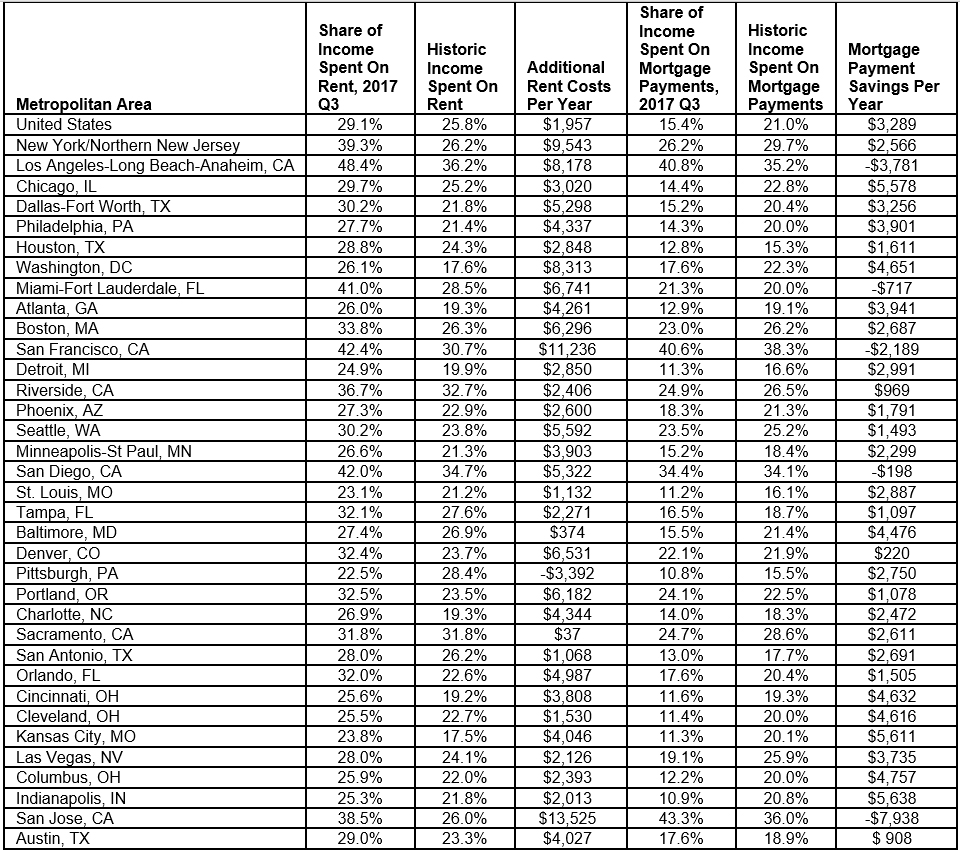
Incomes are not keeping pace with rents.

More earnings are needed for rent than in years past—now 29.1 percent of the median monthly income, versus the 25.8 percent needed prior to the recession, according to an analysis recently released by Zillow. The difference equals $1,957 more than if the share had stayed the same.

Homeowners, however, are not allocating more of their income to a mortgage, the analysis shows. A mortgage accounts for 15.4 percent of the median monthly income now, versus 21 percent prior to the recession—$3,289 in savings.

The discrepancy has implications for renters, says Dr. Svenja Gudell, chief economist at Zillow.

“In most markets, current renters are at a disadvantage compared to years past because paying the rent takes up a much larger share of their income than it did before,” Gudell says. “For many people, that can mean less cash to put toward paying off student debt, building an emergency fund, or saving for retirement. For those hoping to buy a home, it could be a significant part of their down payment. For parents, it could mean additional childcare or a family vacation. This is another example of how much worse rent affordability has gotten.”

For more information, please visit www.zillow.com.

Suzanne De Vita is RISMedia’s online news editor. Email her your real estate news ideas at sdevita@rismedia.com.

For the latest real estate news and trends, bookmark RISMedia.com.

The post Homeowners Spend Less, Renters Spend More appeared first on RISMedia.

…read more

From:: Real Estate News

A Compelling Formula for Success: Assist2Sell

By Susanne Dwyer

A Unique Advantage to the Real Estate Landscape

When it comes to companies offering a discount model, there is plenty of competition. Brokers and agents have long understood that sellers want to pay lower commission rates. But they also want full service, notes Ryan Elliott, vice president of Assist2Sell, and that’s his company’s premier distinction. Founded in Reno, Nev., in 1987 by a pair of independent REALTORS® who saw a shift in the industry, Assist2Sell was created to marry the two concepts—low commission and full service—in an advantageous way…as a full-service discount business model that exceeds consumer expectations while offering unlimited opportunity to a growing cadre of agents and franchise owners. “To be successful in today’s real estate world, it helps to have a unique advantage,” says Elliott. “There has never been a better time for a business model like Assist2Sell.” In this exclusive interview, Elliott shares the company’s unique vision, and the strategies that help their franchisees become front-line competitors.

Barbara Pronin: Tell us a little more about the founding strategy of the company, and how the concept took off.
Ryan Elliott:
Actually, the original motivation the founders Mary LaMeres-Pomin and Lyle Martin had was based on their frustration in spending 80 percent of their time looking for their next deal. They were successful agents with a strong base of repeat and referral customers, but struggled with adding new business. Theirs was a small, traditional office—just the two of them and a support person. When they did get a chance to pitch a new seller for a listing, they would sometimes lose the listing based on their small office size. Sellers perceived that an office with a lot of agents meant those agents would all be trying to sell their homes. We all know that’s not true, and that the MLS levels the playing field, but convincing sellers was a challenge. When they decided to try to attract more business by lowering their fees, and took the bold step to advertise this, all of a sudden, the sellers didn’t care about the number of agents in their office. The concept was pretty simple, and it hasn’t changed: If you charge home sellers a very competitive fee, provide the same services your competition offers, and deliver results, you can increase volume more than enough to make up for the lower fees. That’s what Mary and Lyle started with and it’s what has helped us grow into a familiar brand with hundreds of offices all over North America.

BP: What’s your own career path been like, Ryan? What brought you to the company’s leadership team?
RE:
My dad was a general contractor in Reno, mainly building homes on speculation, and he thought I could help on the sales side. So, I got my real estate license and went to work for a traditional brokerage in Reno. I was aware of Assist2Sell but, like other agents, I didn’t see them as a threat. But after losing a couple of listings to them, the final straw was when …read more

From:: Real Estate News

ICYMI: Demand/Supply Dynamics Keep Prices Tracking Up

By Susanne Dwyer

Home prices tracked up in the latest S&P CoreLogic/Case-Shiller Indices, up 6.2 percent year-over-year in September, compared to 5.9 percent in August. Conditions as they are are prompting the rise.

The S&P CoreLogic Case-Shiller U.S. National Home Price NSA Index’s 10-City Composite rose 5.7 percent year-over-year, up from 5.2 percent in August, while its 20-City Composite rose 6.2 percent year-over-year, up from 5.8 percent in August. Month-over-month, the 10-City Composite and the 20-City Composite both rose, 0.5 percent and 0.4 percent, respectively.

Of the 20 cities analyzed, Las Vegas, Nev., San Diego, Calif., and Seattle, Wash., came out on top, with prices up 9.0 percent year-over-year in Las Vegas, 8.2 percent in San Diego and 12.9 percent in Seattle.

“Most economic indicators suggest that home prices can see further gains,” says David M. Blitzer, S&P Dow Jones Indices chairman of the Index Committee and managing director. “Rental rates and home prices are climbing, the rent-to-buy ratio remains stable, the average rate on a 30-year mortgage is still under 4 percent, and at a 3.8-month supply, the inventory of homes for sale is still low. The overall economy is growing, with the unemployment rate at 4.1 percent, inflation at 2 percent and wages rising at 3 percent or more. One dark cloud for housing is affordability—rising prices mean that some people will be squeezed out of the market.”

“Home prices, after multiple years of fast growth, still show no signs of cooling because of the ongoing housing shortage in much of the country,” said Lawrence Yun, chief economist of the National Association of REALTORS® (NAR), in a statement on the Indices. “The latest Case-Shiller price growth of 6.2 percent on a nationwide basis marks the strongest rise in over three years. This fast appreciation over income growth is not sustainable over many years.

“Housing demand is clearly rising from the improving labor market, but supply is still not kicking higher,” Yun said. “Homes for sale are quickly going under contract, and overall existing inventory has fallen for 29 consecutive months (on a year-over-year basis). Either demand will be choked off from weakening affordability, or more robust construction needs to take place to calm home prices. The latter is the much preferred outcome, and would be a win for homebuyers, a win for home builders and win for faster economic growth.”

Source: S&P Dow Jones Indices

For the latest real estate news and trends, bookmark RISMedia.com.

The post ICYMI: Demand/Supply Dynamics Keep Prices Tracking Up appeared first on RISMedia.

…read more

From:: Finance and Economy

ICYMI: Demand/Supply Dynamics Keep Prices Tracking Up

By Susanne Dwyer

Home prices tracked up in the latest S&P CoreLogic/Case-Shiller Indices, up 6.2 percent year-over-year in September, compared to 5.9 percent in August. Conditions as they are are prompting the rise.

The S&P CoreLogic Case-Shiller U.S. National Home Price NSA Index’s 10-City Composite rose 5.7 percent year-over-year, up from 5.2 percent in August, while its 20-City Composite rose 6.2 percent year-over-year, up from 5.8 percent in August. Month-over-month, the 10-City Composite and the 20-City Composite both rose, 0.5 percent and 0.4 percent, respectively.

Of the 20 cities analyzed, Las Vegas, Nev., San Diego, Calif., and Seattle, Wash., came out on top, with prices up 9.0 percent year-over-year in Las Vegas, 8.2 percent in San Diego and 12.9 percent in Seattle.

“Most economic indicators suggest that home prices can see further gains,” says David M. Blitzer, S&P Dow Jones Indices chairman of the Index Committee and managing director. “Rental rates and home prices are climbing, the rent-to-buy ratio remains stable, the average rate on a 30-year mortgage is still under 4 percent, and at a 3.8-month supply, the inventory of homes for sale is still low. The overall economy is growing, with the unemployment rate at 4.1 percent, inflation at 2 percent and wages rising at 3 percent or more. One dark cloud for housing is affordability—rising prices mean that some people will be squeezed out of the market.”

“Home prices, after multiple years of fast growth, still show no signs of cooling because of the ongoing housing shortage in much of the country,” said Lawrence Yun, chief economist of the National Association of REALTORS® (NAR), in a statement on the Indices. “The latest Case-Shiller price growth of 6.2 percent on a nationwide basis marks the strongest rise in over three years. This fast appreciation over income growth is not sustainable over many years.

“Housing demand is clearly rising from the improving labor market, but supply is still not kicking higher,” Yun said. “Homes for sale are quickly going under contract, and overall existing inventory has fallen for 29 consecutive months (on a year-over-year basis). Either demand will be choked off from weakening affordability, or more robust construction needs to take place to calm home prices. The latter is the much preferred outcome, and would be a win for homebuyers, a win for home builders and win for faster economic growth.”

Source: S&P Dow Jones Indices

For the latest real estate news and trends, bookmark RISMedia.com.

The post ICYMI: Demand/Supply Dynamics Keep Prices Tracking Up appeared first on RISMedia.

…read more

From:: Real Estate News

Maximum Loan Limits Increase on Fannie, Freddie Mortgages

By Susanne Dwyer

The maximum conforming loan limits for mortgages acquired by Fannie Mae and Freddie Mac will increase to $453,100 for most markets in 2018, the Federal Housing Finance Agency (FHFA) recently announced. The increase in the baseline loan limit, mandated by the Housing and Economic Recovery Act (HERA), is in response to rising values.

The maximum loan limit will be higher in high-priced markets were 115 percent of the median home value exceeds the baseline loan limit; the ceiling on that limit is 150 percent of the baseline loan limit. That ceiling, according to the FHFA, will increase to $679,650 for one-unit properties in high-priced markets, with the potential for even higher limits in Alaska, Guam, Hawaii and the U.S. Virgin Islands.

View the maximum loan limits by county.

Source: Federal Housing Finance Agency (FHFA)

For the latest real estate news and trends, bookmark RISMedia.com.

The post Maximum Loan Limits Increase on Fannie, Freddie Mortgages appeared first on RISMedia.

…read more

From:: Real Estate News

Great Spaces: Boutique Residential Development in South Kensington, London

By Susanne Dwyer

A new development is being launched in South Kensington, London, encompassing 11 uniquely appointed apartments and a single townhouse residence. The Arts House in Southwell Gardens, located in the cultural heartland of London, has a selection of one-, two- and three-bedroom layouts available. Exquisite marble-topped counters with spacious living areas are some of the premier features.

Named in recognition of the artistic and academic heritage of the area, The Arts House has been meticulously restored from its former dilapidated state to offer beautifully finished bright, spacious apartments. The period facade, including original porticos and ornate replicated balustrades, has been retained, and internally, the apartments benefit from elaborate cornicing, elevated ceiling heights and period-style tiled flooring in the foyer. While window ledge detailing has been retained, acoustically engineered windows have been incorporated to enhance energy efficiency and ensure complete peace and quiet. Connected by an original central staircase, in addition to a newly installed passenger lift, the apartments range from 798-1,879 square feet in size and have been finished to the highest level of contemporary specification.

In keeping with the appeal of Kensington, the period design was maintained with the addition of all modern necessities. The development is well suited to those who are passionate about art and culture, as numerous gems are located in the vicinity, including the Victoria and Albert Museum, the National History Museum and Hyde Park. The Arts House sits directly across from Saint Stephen’s Church, where T.S. Eliot served as church warden for over 30 years.

For more information, please visit theartshouse.co.uk.

Zoe Eisenberg is RISMedia’s senior content editor. Email her your real estate news ideas at zoe@rismedia.com.

For the latest real estate news and trends, bookmark RISMedia.com.

The post Great Spaces: Boutique Residential Development in South Kensington, London appeared first on RISMedia.

…read more

From:: Real Estate News