House passes bill to fund government through Jan. 19

The House passed a bill Thursday to fund the federal government through Jan. 19, sending the measure to the Senate. If approved in the Senate, the bill would head off a partial shutdown this weekend. In addition to extending agency funding at current levels, it would fund the Children’s Health Insurance Program, or CHIP, through the end of March. The House bill also contains language preventing automatic spending cuts to programs including Medicare. Approval of that language would allow President Donald Trump to sign the Republican tax bill before January.

Market Pulse Stories are Rapid-fire, short news bursts on stocks and markets as they move. Visit MarketWatch.com for more information on this news.

…read more

From:: Stock Market News

Rise In Mortgage Rates Could Continue

Interest rates increased last month and were also higher this week. Short-term and long-term predictions have further rate increases ahead.

At 4.24 percent, average 30-year note rates on mortgages that closed in November were 4 basis points more than they were during the preceding month.

The increase was far more substantial compared to the same 30-day period last year, when 30-year residential loan rates averaged 3.81 percent.


…read more

From:: Financing

Americans ‘Concerned’ About Homeownership in Light of Tax Bill

By Susanne Dwyer

Americans are concerned about homeownership in response to the Tax Cuts and Jobs Act, according to new realtor.com® research. The legislation, awaiting President Trump’s signature (at press time), passed on Wednesday this week.

More than one-third (36.2 percent) of respondents to a realtor.com survey, conducted Dec. 18-19 prior to the passage, were “concerned” about being a homeowner; 17.2 percent were “very concerned.” Just one-quarter of respondents, roughly, felt “positive” or “very positive” about the doubled standard deduction, and only about half that (12.4 percent) felt “very positive” about the elimination of the second-home mortgage interest deduction (MID). The bill doubles the standard deduction, from $13,000 to $24,000 for married taxpayers and from $6,500 to $12,000 for single taxpayers, and removes the MID on second homes.

Additionally, the bill is motivating some to move quicker—or not at all. Almost 14 percent of respondents to the survey said they will list their home sooner, while 7.6 percent said they will hold off on their plans to sell. Close to 30 percent of respondents, meanwhile, said they will buy faster; 14.2 percent will buy a cheaper home; 12 percent will delay their plans to purchase; and 2.3 percent will house-hunt in another location.

Notably, 57.1 percent of respondents to the survey believed the legislation will not impact their plans to sell, and 22.9 percent believed it will not impact their plans to purchase.

The bill caps the MID on new loans for primary residences at $750,000—a cut from the existing $1 million, but higher than the $500,000 originally proposed by House Republicans. The bill also:

  • Eliminates the MID for home equity loans, unless the funds go to home improvements;
  • Limits the state and local income, property and sales tax deduction to $10,000
  • Preserves the exclusion on capital gains on home sales

“The bill will have a significant impact on the housing market and overall economy, so it makes sense that people are wondering what it means to them,” says Joseph Kirchner, senior economist at realtor.com. “Some house hunters—particularly wealthy buyers—will see an increase in after-tax income, making an already tough housing market even more competitive. This increased demand could drive prices up even higher than they are already. And changes in the deductibility of mortgage interest and state and local taxes could cause challenges for many homeowners.”

Earlier this month, realtor.com Chief Economist Danielle Hale estimated homeowners in California, Maryland, New Jersey and New York would bear the brunt of the changes. California, especially—with its high prices—would be hard-hit.

“High housing costs in California [make] it the state with the third-highest average mortgage interest deduction, behind Hawaii and the District of Columbia,” said Hale. “…Lower-priced housing markets will also eventually be impacted.”

“While the impact of this bill may not be as harmful in many parts of the country, here in California, where the typical home costs two-and-a-half times the national home price, homeowners and would-be buyers will be hit especially hard,” said California Association of REALTORS® (C.A.R.) President Steve White following the passage.

The National Association of REALTORS® (NAR) acknowledged …read more

From:: Finance and Economy

Americans ‘Concerned’ About Homeownership in Light of Tax Bill

By Susanne Dwyer

Americans are concerned about homeownership in response to the Tax Cuts and Jobs Act, according to new realtor.com® research. The legislation, awaiting President Trump’s signature (at press time), passed on Wednesday this week.

More than one-third (36.2 percent) of respondents to a realtor.com survey, conducted Dec. 18-19 prior to the passage, were “concerned” about being a homeowner; 17.2 percent were “very concerned.” Just one-quarter of respondents, roughly, felt “positive” or “very positive” about the doubled standard deduction, and only about half that (12.4 percent) felt “very positive” about the elimination of the second-home mortgage interest deduction (MID). The bill doubles the standard deduction, from $13,000 to $24,000 for married taxpayers and from $6,500 to $12,000 for single taxpayers, and removes the MID on second homes.

Additionally, the bill is motivating some to move quicker—or not at all. Almost 14 percent of respondents to the survey said they will list their home sooner, while 7.6 percent said they will hold off on their plans to sell. Close to 30 percent of respondents, meanwhile, said they will buy faster; 14.2 percent will buy a cheaper home; 12 percent will delay their plans to purchase; and 2.3 percent will house-hunt in another location.

Notably, 57.1 percent of respondents to the survey believed the legislation will not impact their plans to sell, and 22.9 percent believed it will not impact their plans to purchase.

The bill caps the MID on new loans for primary residences at $750,000—a cut from the existing $1 million, but higher than the $500,000 originally proposed by House Republicans. The bill also:

  • Eliminates the MID for home equity loans, unless the funds go to home improvements;
  • Limits the state and local income, property and sales tax deduction to $10,000
  • Preserves the exclusion on capital gains on home sales

“The bill will have a significant impact on the housing market and overall economy, so it makes sense that people are wondering what it means to them,” says Joseph Kirchner, senior economist at realtor.com. “Some house hunters—particularly wealthy buyers—will see an increase in after-tax income, making an already tough housing market even more competitive. This increased demand could drive prices up even higher than they are already. And changes in the deductibility of mortgage interest and state and local taxes could cause challenges for many homeowners.”

Earlier this month, realtor.com Chief Economist Danielle Hale estimated homeowners in California, Maryland, New Jersey and New York would bear the brunt of the changes. California, especially—with its high prices—would be hard-hit.

“High housing costs in California [make] it the state with the third-highest average mortgage interest deduction, behind Hawaii and the District of Columbia,” said Hale. “…Lower-priced housing markets will also eventually be impacted.”

“While the impact of this bill may not be as harmful in many parts of the country, here in California, where the typical home costs two-and-a-half times the national home price, homeowners and would-be buyers will be hit especially hard,” said California Association of REALTORS® (C.A.R.) President Steve White following the passage.

The National Association of REALTORS® (NAR) acknowledged …read more

From:: Real Estate News

Celgene stock falls after Revlimid cancer study fails

Celgene Corp. shares declined more than 4% in late trading Thursday after revealing that a phase II study of a cancer drug failed to meet its goal. Celgene said that a study testing Revlimid on follicular lymphoma did not meet the desired endpoint. Revlimid is already approved for other forms of cancer, and is Celgene’s biggest drug in terms of revenue, producing $7 billion in sales in 2016 before price hikes last year. “We remain committed to advancing our broad pipeline of novel therapies to establish new standards of care for patients with lymphoma,” Chief Medical Officer Jay Backstrom said in the announcement. Celgene stock fell to $103.50 in late trading, after closing with a 0.4% decline at $107.88.

Market Pulse Stories are Rapid-fire, short news bursts on stocks and markets as they move. Visit MarketWatch.com for more information on this news.

…read more

From:: Stock Market News

Cintas stock jumps 4% on earnings beat, increased guidance

Shares of Cintas Corp. rose nearly 4% late Thursday after the uniform-rental company reported fiscal 2018 second-quarter earnings and sales above Wall Street expectations and raised its guidance for the full fiscal year. Cintas said it earned $137 million, or $1.23 a share, in the quarter, compared with $140 million, or $1.29 a share, in the year-ago period. Revenue rose 26% to $1.61 billion, compared with $1.27 billion a year ago. Analysts polled by FactSet had expected earnings of $1.21 a share on sales of $1.59 billion. Cintas also raised its revenue guidance from a range of $6.325 billion to $6.400 billion to a range of $6.365 billion to $6.430 billion, and EPS from continuing operations from a range of $5.30 to $5.38 to a range of $5.39 to $5.46, the company said. Cintas shares ended the regular trading day up 0.4%.

Market Pulse Stories are Rapid-fire, short news bursts on stocks and markets as they move. Visit MarketWatch.com for more information on this news.

…read more

From:: Stock Market News

Inventory at Lowest Since 2013

By Susanne Dwyer

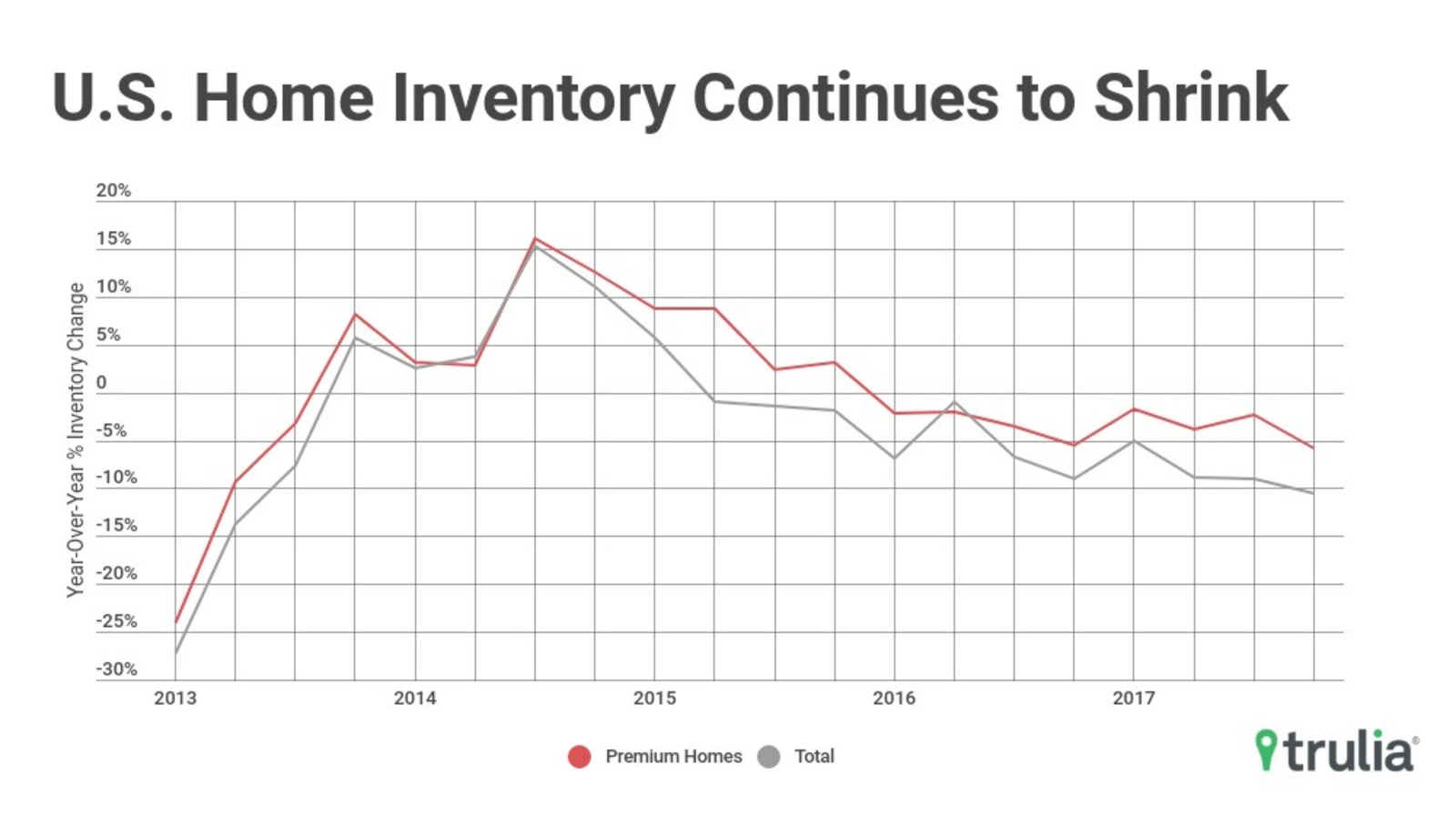
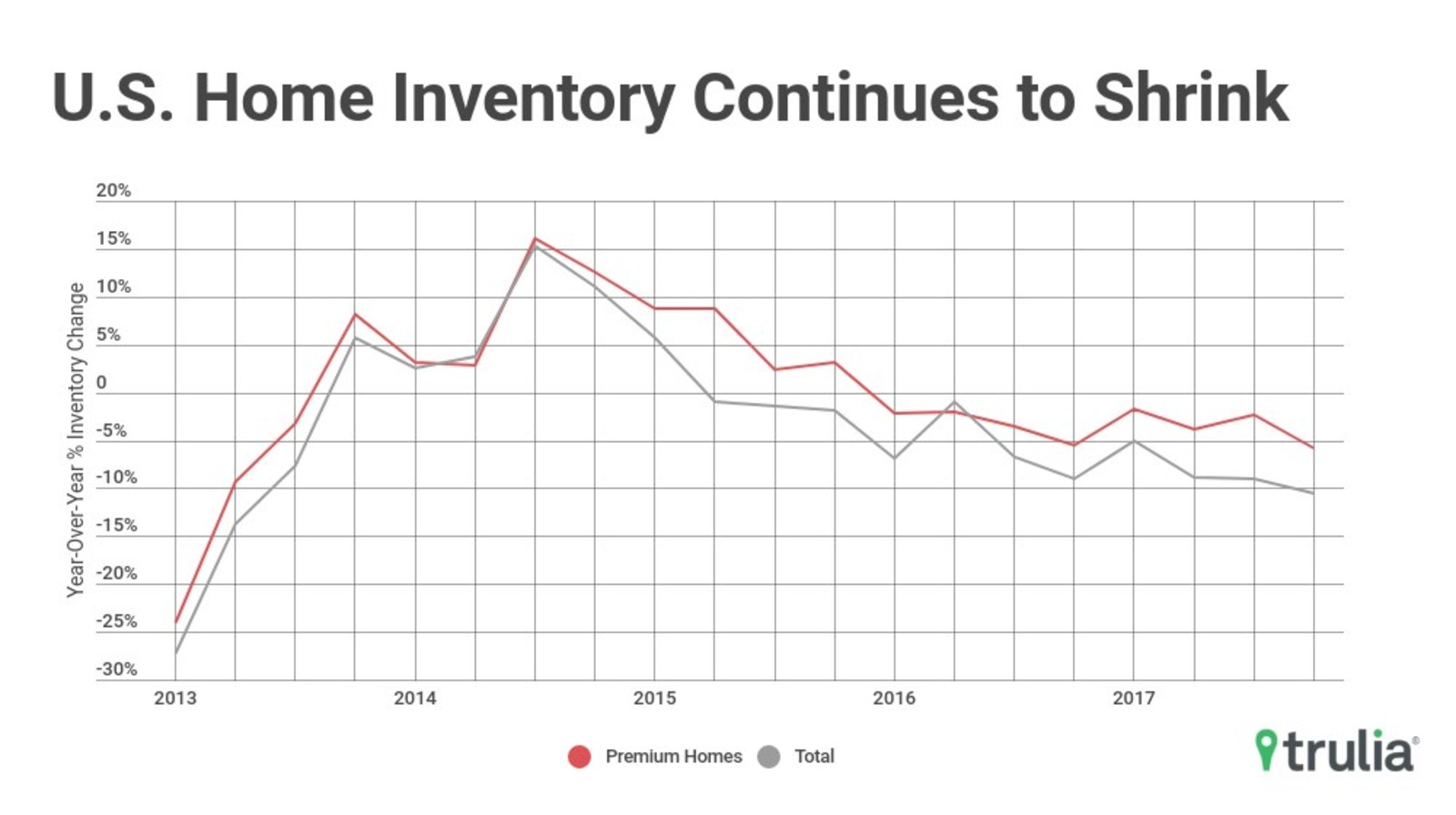
Housing inventory is shrinking, still, according to the recently released Trulia Inventory and Price Watch for the fourth quarter of 2017. Across the board, in the premium, starter and trade-up tiers, inventory has tumbled 10.5 percent year-over-year—the most considerable drop-off since 2013.

The issue is most pervasive at the entry level, which accounts for just 22.9 percent of available inventory. To compare, higher-end, or premium, supply comprises 53.1 percent.

“While the number of premium homes on the market have seen a sharp fall, they continue to make up a larger share of the for-sale market, which spells trouble for first-time homebuyers,” says Ralph McLaughlin, chief economist at Trulia. “Coupled with record-low inventory, saving enough money for a down payment will continue to be their biggest obstacle to homeownership.”

Affordability, as such, has dwindled. Buying a starter home necessitates 39.8 percent of monthly income, up 1.7 percent from the fourth quarter of 2016; buying a trade-up or premium home requires 25.8 percent and 14.0 percent, respectively.

The crisis could take a turn, however.

“While the inventory crunch continues, I’m cautiously optimistic that 2018 will be a year for inventory rebound,” McLaughlin says. “Not only is American optimism about selling homes at levels not seen since 2014, 16 percent of homeowners plan to sell a home in the next two years. If we see them follow through, there may finally be an uptick in inventory.”

For more information, please visit www.trulia.com.

For the latest real estate news and trends, bookmark RISMedia.com.

The post Inventory at Lowest Since 2013 appeared first on RISMedia.

…read more

From:: Finance and Economy

Finish Line upgraded on ‘conservative’ same-store sales guidance

Finish Line Inc. was upgraded to market perform from underperform at Cowen & Company on fiscal fourth-quarter guidance that analysts call “conservative.” Last year, fourth-quarter same-store sales fell 4.5%, largely due to delayed tax refunds and a gross margin decline. In the third-quarter earnings announcement early Thursday, Finish Line reported 0.8% same-store sales growth, exceeding the 4.5% decline FactSet forecast. Cowen thinks positive trends and an easy comparison make the guidance for 3%-to-5% same-store sales decline modest. However, analysts remain cautious. “We don’t see a catalyst for Finish Line’s sales to meaningfully increase on a sustainable long-term basis given the amount of store closures and competitive environment,” the note said. Finish Line shares are up more than 13% in Thursday trading, but down 37% for the past year. The S&P 500 index is up 18.6% for the last 12 months.

Market Pulse Stories are Rapid-fire, short news bursts on stocks and markets as they move. Visit MarketWatch.com for more information on this news.

…read more

From:: Stock Market News

Biogen price target raised 20% to $420 at Instinet, citing ‘meaningful 2018 for the company’

Biogen Inc.’s price target was raised 18% to $420 by Instinet on Thursday, citing its expectation of “a meaningful 2018 for the company.” The price target increase comes as Biogen shares have slid 3% after a negative analysis was released for one of its Alzheimer’s disease drug trials. Instinet analyst Christopher Marai, however, noted high hopes for the company’s spinal muscular atrophy therapy Spinraza, agreements Biogen has with companies like Alkermes and Eisai and the company’s much-anticipated other Alzheimer’s disease drug, aducanumab. “In our view, potentially positive catalysts from BIIB’s both widely covered and underappreciated mid- to late-stage pipeline assets (which we do not yet include in our own estimates) will not only be stock-moving but also index-moving, making BIIB ‘a must own name.'” Biogen shares have risen 2.6% over the last three months to $323.23, compared with a 7.5% rise in the S&P 500 and a 10.6% rise in the Dow Jones Industrial Average .

Market Pulse Stories are Rapid-fire, short news bursts on stocks and markets as they move. Visit MarketWatch.com for more information on this news.

…read more

From:: Stock Market News

Resilient oil ends with modest gains

U.S. oil futures bounced back from early weakness to end modestly higher Thursday, with analysts citing a backdrop of strong refinery demand and falling crude inventories, though upside remained capped by concerns over rising domestic production. West Texas Intermediate crude for February delivery on the New York Mercantile Exchange rose 27 cents, or 0.5%, to close at $58.36 a barrel.

Market Pulse Stories are Rapid-fire, short news bursts on stocks and markets as they move. Visit MarketWatch.com for more information on this news.

…read more

From:: Stock Market News