Disaster Protocol: Is Your Company Prepared for the Worst?

By Susanne Dwyer

Pappas_Christina_60x60

This month’s National Association of REALTORS® (NAR) Power Broker Roundtable discusses broker disaster/emergency policies and procedures.

Moderator

Christina Pappas, District Sales Manager, The Keyes Company, Miami, Fla.; Liaison for Large Firms & Industry Relations, NAR

Panelists

Rick Haase, President, Latter & Blum, Inc., REALTORS®, New Orleans, La.

Goldschlag_Marnie_60x60Marnie Goldschlag, Co-Owner, NextHome Wine Country Premier, Santa Rosa, Calif.

Mesa_Rei_60x60Rei Mesa, CEO, Berkshire Hathaway HomeServices Florida Realty, Miami, Fla.

Saunders_Michael_60x60Michael Saunders, CEO, Michael Saunders & Co. Realtors, Sarasota, Fla.

Christina Pappas: Around the world, 2017 was an extraordinary year in terms of natural disasters. Fires, floods, hurricanes and earthquakes inundated numerous areas, threatening lives and testing resources even in regions not typically thought of as being particularly at risk. There is almost no way to adequately measure the cost in terms of lives and property—or, for that matter, the bravery and resolve it is still taking as we work to repair the damage. But one thing is clear: Whether we are testing disaster protocols long in place, or newly struggling to create procedures to help bring order out of chaos, tragedies like these present an alarming call to action. How prepared are you and your company to effectively face catastrophe? Rick, in your markets, Hurricane Harvey was only the most recent disaster. What protocols have you had in place, and what advice would you offer?

Rick Haase: First, let me say that even if you have procedures in place, it isn’t until you experience substantial threat that you find out how protected you really are. In our case, the Katrina disaster became a mental model for me. Once we dug our way out of that, we seriously scrutinized every area of our business, and we came up with questions we needed to answer: Do we have a central number in place where agents and employees—some of whom suffered personal loss—can get emergency information? Can we get into our accounting system so that payroll is not disrupted when our people need it most? Today, our operations are totally portable and accessible. Even if an office or two are nine feet underwater, we can operate from a remote area, get those paychecks out, and keep backup procedures running.

Marnie Goldschlag: Having recently been through the devastating—and totally unanticipated—fires in Santa Rosa, I can certainly relate to that…and we quickly realized the need for outreach extends to our client base, as well. My partners and I called every agent first to determine how they were and what they needed, and then had them call everyone on their client lists. As it turned out, my business partner and I alone had 12 of our clients who lost their homes, and our office agents have similar stories. Our agents were out there with them, helping to deal with insurance agents and sift through the ashes for any salvageable possessions. This was a test of community, which is what our …read more

From:: Real Estate News
10 Percent and Falling: Housing Inventory Keeps Shrinking

By Susanne Dwyer

Zillow_Dec_17

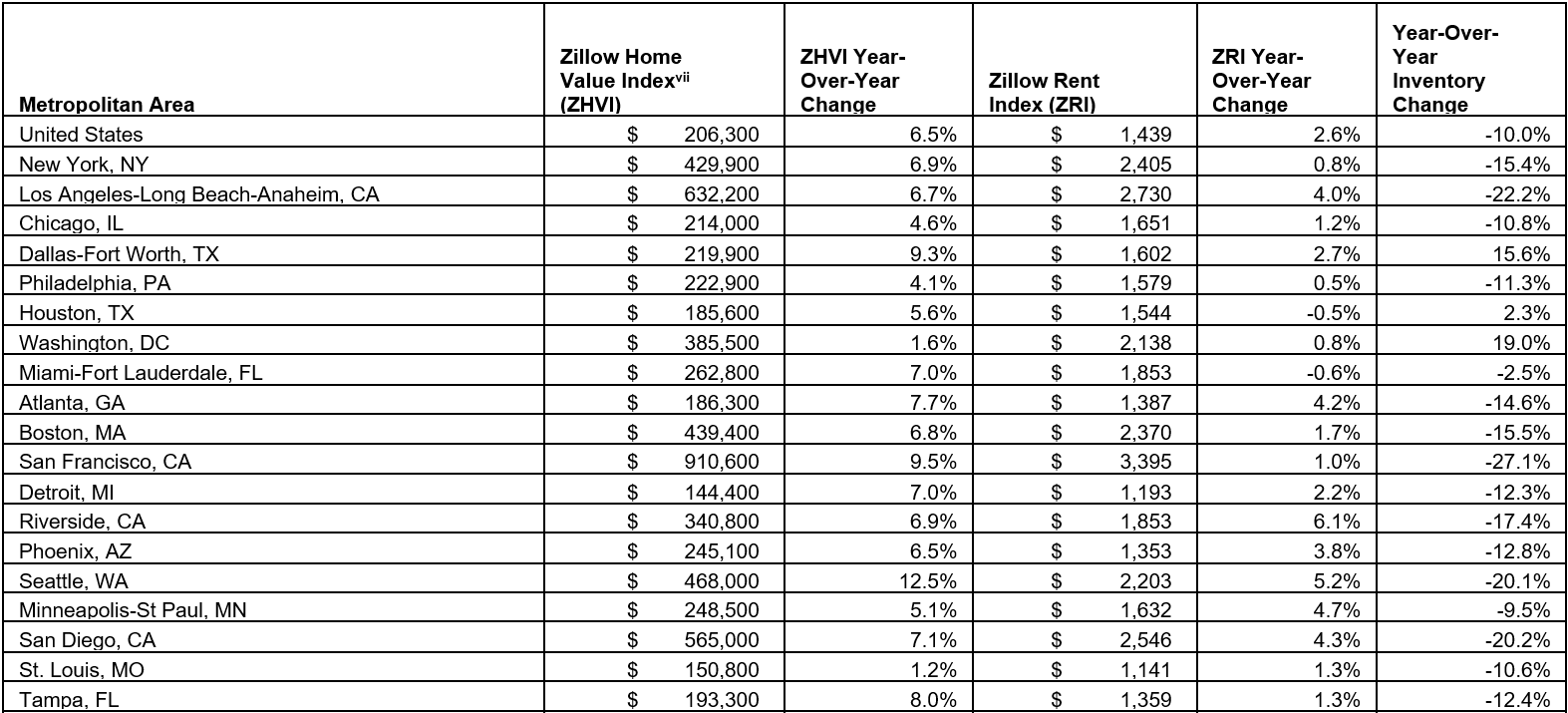
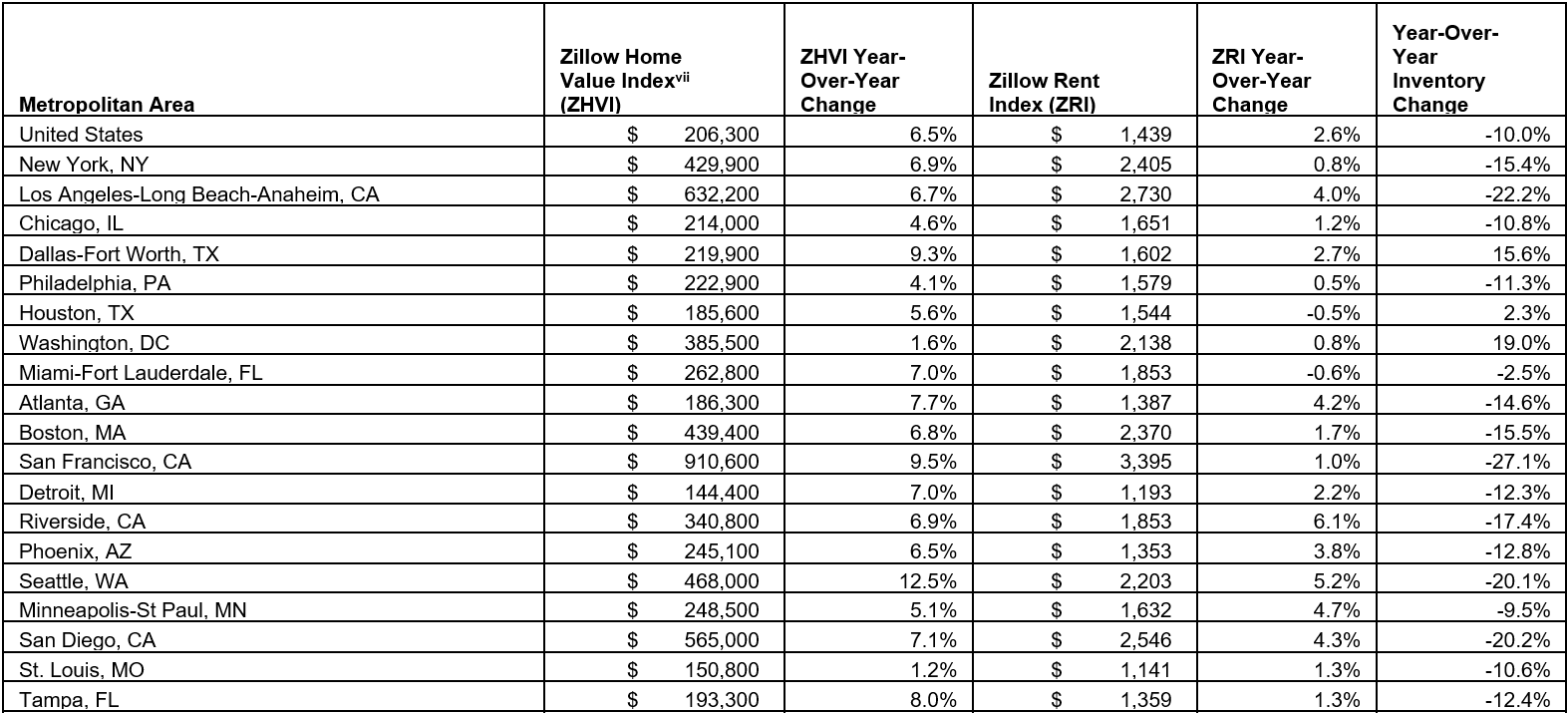
Buyers are being challenged by diminished inventory and mounting prices, especially in areas with crisis-level supply, according to the December Zillow® Real Estate Market Report. Inventory is down 10 percent from last year—a three-year trend—and, in the buzziest markets, as much as 40 percent.

Construction costs are exacerbating the issue, says Aaron Terrazas, senior economist at Zillow, who anticipates building will be concentrated in outlying suburbs this year.

“On the supply side, the market is starving for new homes, but it won’t be easy for builders struggling with high and rising land, labor and lumber costs,” Terrazas says. “Aging millennials and young families may be able to find more affordable new homes for sale this year, but they’ll most likely be in further-flung suburbs with more grueling commutes to urban job centers.”

Few homes are moving prices up—6.5 percent in the past year, to a median $206,300, according to the Zillow Home Value Index (ZHVI). Appreciation has been highest in San Jose, Calif., at 21.2 percent (a median $1,171,800), causing inventory to shrink 40.6 percent. In the largest metros:

Markedly, a mere 16.7 percent of analysts cited in Zillow’s 2017 Q4 Home Price Expectations Survey forecast home-building will pick up this year. In December, ground-breaking on new homes underwhelmed; builders, however, are confident in their prospects this year, according to the National Association of Home Builders (NAHB).

Changes to the expected could come when the Tax Cuts and Jobs Act goes into effect, says Terrazas.

“Tight inventory fueled by a tight labor market and low interest rates propelled home values to record heights in 2017, but the outlook is now much less certain,” Terrazas says. “Tax reform will put more money in the pocket of the typical buyer, but will limit some housing-specific deductions. Overall, this should increase demand for the most affordable homes and ease competition somewhat in the priciest market segments.”

MORE: Tax Reform: Here’s What Could Impact Homeowners Most

For more information, please visit www.zillow.com.

Suzanne De Vita is RISMedia’s online news editor. Email her your real estate news ideas at sdevita@rismedia.com. For the latest real estate news and trends, bookmark RISMedia.com.

The post 10 Percent and Falling: Housing Inventory Keeps Shrinking appeared first on RISMedia.

…read more

From:: Real Estate News

10 Percent and Falling: Housing Inventory Keeps Shrinking

By Susanne Dwyer

Zillow_Dec_17

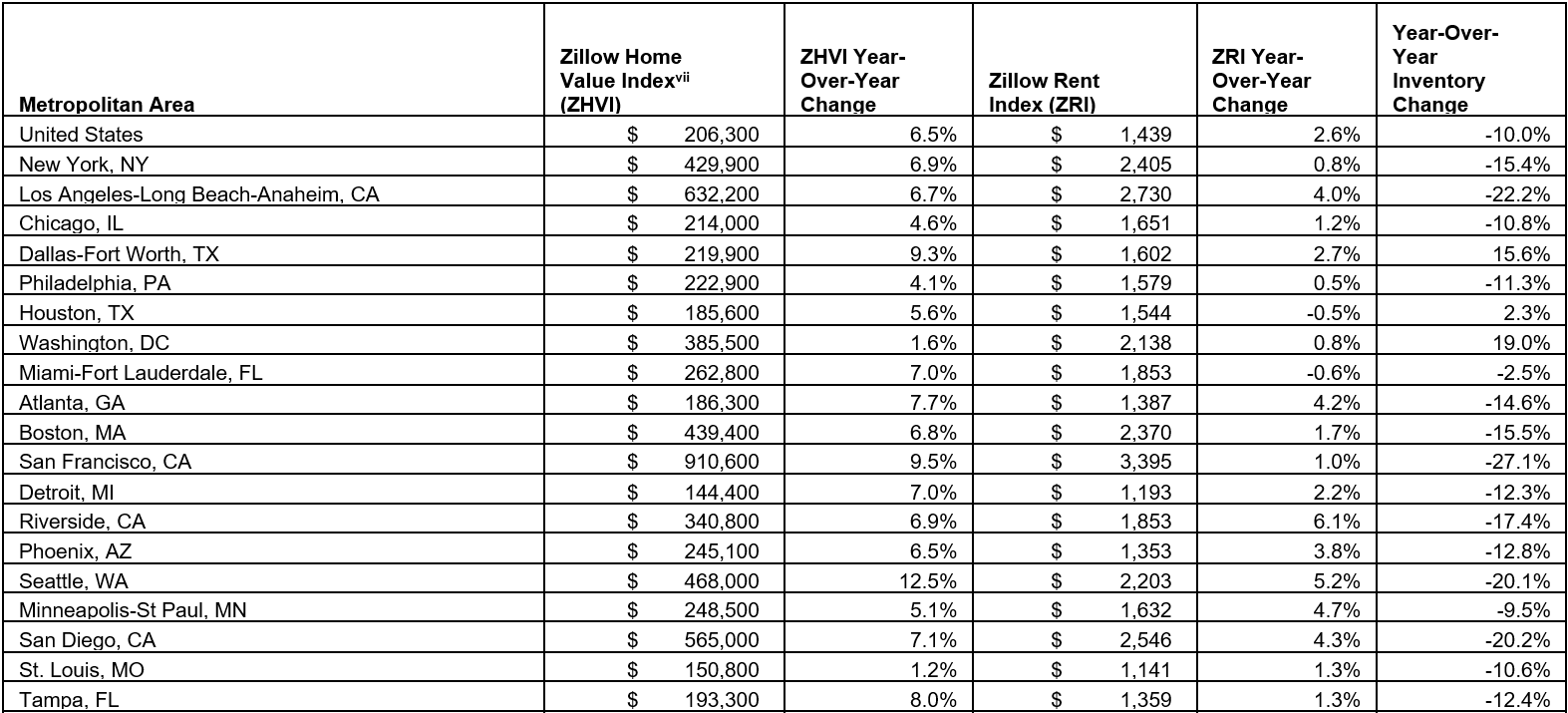
Buyers are being challenged by diminished inventory and mounting prices, especially in areas with crisis-level supply, according to the December Zillow® Real Estate Market Report. Inventory is down 10 percent from last year—a three-year trend—and, in the buzziest markets, as much as 40 percent.

Construction costs are exacerbating the issue, says Aaron Terrazas, senior economist at Zillow, who anticipates building will be concentrated in outlying suburbs this year.

“On the supply side, the market is starving for new homes, but it won’t be easy for builders struggling with high and rising land, labor and lumber costs,” Terrazas says. “Aging millennials and young families may be able to find more affordable new homes for sale this year, but they’ll most likely be in further-flung suburbs with more grueling commutes to urban job centers.”

Few homes are moving prices up—6.5 percent in the past year, to a median $206,300, according to the Zillow Home Value Index (ZHVI). Appreciation has been highest in San Jose, Calif., at 21.2 percent (a median $1,171,800), causing inventory to shrink 40.6 percent. In the largest metros:

Markedly, a mere 16.7 percent of analysts cited in Zillow’s 2017 Q4 Home Price Expectations Survey forecast home-building will pick up this year. In December, ground-breaking on new homes underwhelmed; builders, however, are confident in their prospects this year, according to the National Association of Home Builders (NAHB).

Changes to the expected could come when the Tax Cuts and Jobs Act goes into effect, says Terrazas.

“Tight inventory fueled by a tight labor market and low interest rates propelled home values to record heights in 2017, but the outlook is now much less certain,” Terrazas says. “Tax reform will put more money in the pocket of the typical buyer, but will limit some housing-specific deductions. Overall, this should increase demand for the most affordable homes and ease competition somewhat in the priciest market segments.”

MORE: Tax Reform: Here’s What Could Impact Homeowners Most

For more information, please visit www.zillow.com.

Suzanne De Vita is RISMedia’s online news editor. Email her your real estate news ideas at sdevita@rismedia.com. For the latest real estate news and trends, bookmark RISMedia.com.

The post 10 Percent and Falling: Housing Inventory Keeps Shrinking appeared first on RISMedia.

…read more

From:: Finance and Economy

Germany’s Social Democrats vote in favor of coalition talks with Merkel

Germany’s Social Democratic Party voted in favor to start official coalition negotiations with Chancellor Angela Merkel’s Christian Democrats on Sunday. The vote, which took place at a special party convention, was tight with 362 party members voting in favor and 279 against the coalition, according to local reports. Chancellor Merkel was handed another term by the German people in the September election but has been unable to form a majority government since. The SPD and CDU have a history of coalition governing but butted heads on topics like immigration and taxes this time around.

Market Pulse Stories are Rapid-fire, short news bursts on stocks and markets as they move. Visit MarketWatch.com for more information on this news.

…read more

From:: Stock Market News

White House says President Trump in regular contact Saturday with Hill Republicans over funding

President Trump remains in regular contact so far on Saturday with congressional Republicans, including several conversations with Senate Majority Leader Mitch McConnell and a discussion with House Speaker Paul Ryan, White House press secretary Sarah Huckabee Sanders said in a statement. She said Trump will not negotiate on immigration until the Democrats “stop playing games and reopen the government.” Lack of a funding bill agreement overnight pushed the U.S. into its first government shutdown since 2013. Both chambers reconvened Saturday afternoon. Trump, who is marking the one-year anniversary of his inauguration on Saturday, had so far postponed a trip to his Florida resort Mar-a-Lago, where supporters are meeting for a $100,000-a-couple fundraising gala. CNN reports the party will go on even if the president remains in Washington as he has pledged to do until a funding agreement can be reached.

Market Pulse Stories are Rapid-fire, short news bursts on stocks and markets as they move. Visit MarketWatch.com for more information on this news.

…read more

From:: Stock Market News

Achieving Financial Wellness in 2018 and Beyond

By Susanne Dwyer

Financial security during your working years, and in retirement, is a top priority for every member of the National Association of REALTORS® (NAR). However, since most members work as independent contractors, or brokerage owners/managers, they don’t have access to employer retirement savings plans, making it especially challenging to plan for long-term financial security.

Many REALTORS®, including those who are enjoying success in their careers, do not achieve basic financial planning goals. NAR research shows that:

  • 43 percent are not saving for retirement
  • 42 percent do not feel prepared for a financial emergency
  • Only 46 percent are “completely confident” they can retire when they are ready

Adding to the problem, REALTORS® tend to be extremely busy and preoccupied with helping clients. Early in their career, it’s easy to postpone retirement planning; later, it’s tempting to assume it’s too late to make meaningful improvements.

Turning the Corner
Changing course requires action. Recognizing the importance of the challenge, 2017 NAR President Bill Brown pledged to help members take charge of their financial lives. He convened a Presidential Advisory Group (PAG) of REALTORS® from across the country chaired by NAR Past President Sharon Millett, and met twice for a total of four days to identify and recommend steps to support members’ financial strength through education and other resources. Major recommendations and initiatives stemming from the PAG’s work include:

  1. New Financial Wellness Program
    The PAG’s top recommendation focused on engaging members on the importance of financial wellness and wealth-building, including negotiating with a national financial services firm to provide personalized financial and investment planning services with valuable member benefits for those that participate.

This past November, NAR announced that Bank of America Merrill Lynch had been selected to develop a financial wellness program with customized member benefits. The program will include personalized financial education services, as well as online resources and financial workshops designed to assist NAR members with achieving their financial goals based on age, life stage and needs.

The new Bank of America Merrill Lynch services will be offered through NAR’s REALTOR Benefits® Program. Later this year, watch for a new interactive website (at www.NAR.realtor/Retirement) with worksheets and personal assessments, as well as planning tools that deliver an understanding of budgeting, goal-setting, planning, saving, and investing.

  1. Investing in Real Estate
    Even though REALTORS® are intimately familiar with the benefits of building wealth through real estate, only 30 percent of members own investment properties. NAR’s eight-hour course titled “Real Estate Investing: Build Wealth Representing Investors and Becoming One Yourself” is an excellent resource for honing a smart investment strategy. To learn more about the course and current classroom offerings, visit training4re.com.
  1. Selling Your Business
    With proper planning, many brokers, agents and teams can position their business to be a salable asset upon retirement. NAR’s commitment to financial wellness includes developing best practice tools and “how-to” advice for preparing well-documented records and systems that can help you monetize your book of business at the time of a sale or merger.
  1. Regional Events
    To continue raising awareness and provide additional learning …read more

    From:: Real Estate News

Average 30-Year Mortgage Rate Charges Above 4 Percent

By Susanne Dwyer

The average 30-year, fixed mortgage rate charged to 4.04 percent this week, up from 3.99 percent the week prior, according to Freddie Mac’s Primary Mortgage Market Survey® (PMMS®). The 15-year, fixed rate averaged 3.49 percent, up from 3.44 percent the week prior, while the five-year, Treasury-indexed hybrid adjustable rate averaged 3.46 percent, the same as the week prior.

“The U.S. weekly average for the 30-year fixed mortgage rate rose above 4 percent for the first time since last summer to 4.04 percent in this week’s survey,” says Len Kiefer, deputy chief economist at Freddie Mac. “This is the highest weekly average for the 30-year fixed rate mortgage since May of 2017. Some may be wondering if this is the last time we’ll see a three handle on the 30-year mortgage rate. Never say never, but inflation is firming, the Federal Reserve’s Beige Book indicates broad-based economic growth, and labor markets are tightening. This means upward pressure on long-term rates, like the 30-year fixed-rate mortgage, is building.”

Source: Freddie Mac

For the latest real estate news and trends, bookmark RISMedia.com.

The post Average 30-Year Mortgage Rate Charges Above 4 Percent appeared first on RISMedia.

…read more

From:: Finance and Economy

Average 30-Year Mortgage Rate Charges Above 4 Percent

By Susanne Dwyer

The average 30-year, fixed mortgage rate charged to 4.04 percent this week, up from 3.99 percent the week prior, according to Freddie Mac’s Primary Mortgage Market Survey® (PMMS®). The 15-year, fixed rate averaged 3.49 percent, up from 3.44 percent the week prior, while the five-year, Treasury-indexed hybrid adjustable rate averaged 3.46 percent, the same as the week prior.

“The U.S. weekly average for the 30-year fixed mortgage rate rose above 4 percent for the first time since last summer to 4.04 percent in this week’s survey,” says Len Kiefer, deputy chief economist at Freddie Mac. “This is the highest weekly average for the 30-year fixed rate mortgage since May of 2017. Some may be wondering if this is the last time we’ll see a three handle on the 30-year mortgage rate. Never say never, but inflation is firming, the Federal Reserve’s Beige Book indicates broad-based economic growth, and labor markets are tightening. This means upward pressure on long-term rates, like the 30-year fixed-rate mortgage, is building.”

Source: Freddie Mac

For the latest real estate news and trends, bookmark RISMedia.com.

The post Average 30-Year Mortgage Rate Charges Above 4 Percent appeared first on RISMedia.

…read more

From:: Real Estate News

Average 30-Year Mortgage Rate Charges Above 4 Percent

By Susanne Dwyer

The average 30-year, fixed mortgage rate charged to 4.04 percent this week, up from 3.99 percent the week prior, according to Freddie Mac’s Primary Mortgage Market Survey® (PMMS®). The 15-year, fixed rate averaged 3.49 percent, up from 3.44 percent the week prior, while the five-year, Treasury-indexed hybrid adjustable rate averaged 3.46 percent, the same as the week prior.

“The U.S. weekly average for the 30-year fixed mortgage rate rose above 4 percent for the first time since last summer to 4.04 percent in this week’s survey,” says Len Kiefer, deputy chief economist at Freddie Mac. “This is the highest weekly average for the 30-year fixed rate mortgage since May of 2017. Some may be wondering if this is the last time we’ll see a three handle on the 30-year mortgage rate. Never say never, but inflation is firming, the Federal Reserve’s Beige Book indicates broad-based economic growth, and labor markets are tightening. This means upward pressure on long-term rates, like the 30-year fixed-rate mortgage, is building.”

Source: Freddie Mac

For the latest real estate news and trends, bookmark RISMedia.com.

The post Average 30-Year Mortgage Rate Charges Above 4 Percent appeared first on RISMedia.

…read more

From:: Finance and Economy

David Caveness: Creating Opportunities for Agents

By Susanne Dwyer

Caveness_David

David Caveness, president and CEO of Carpenter REALTORS®, received RISMedia’s National Homeownership Award this past November during the 22nd Annual Power Broker Reception & Dinner, held in conjunction with the 2017 REALTORS® Conference & Expo.

An honor brought about thanks in large part to Caveness’ 43-plus years of excellence in the business, the National Homeownership Award is bestowed upon a member of the real estate community who continuously demonstrates extraordinary contributions toward increasing homeownership and building better communities.

“I decided to get into the real estate business at the age of 16,” says Caveness. “My father, a West Texas guy who earned his living as a doctor, used to take me out to look at ranch land with real estate people, and I thought being a broker was the coolest thing ever.”

So, after graduating high school, Caveness went to the University of Denver, graduating with a BSBA degree in real estate and construction management, entering the business in 1974.

Throughout his esteemed career, Caveness has served as director of Education for the Iowa Association of REALTORS®, national director of Education for Better Homes and Gardens Real Estate Service and general manager for First Realty/Better Homes and Gardens in Des Moines, Iowa, before coming to Carpenter REALTORS® in 1989 as vice president and regional manager. In 2013, he was named president and CEO.

Since coming to the firm, Caveness has helped build the Indianapolis-based company from six offices and 120 agents to where it stands today with 32 offices and 685 agents.

Looking back on 2017, Caveness notes that the robust market has kept things exciting.

“This past year surprised me, as did 2016,” says Caveness. “I’m bewildered by just how strong the market is and how weak the listing inventory is. It’s virtually a fraction of what it was just a few years ago, and yet, this year we’re going to hit record sales in both units and dollar volume.”

As long as the market continues to expand and the company continues to do well, Caveness says Carpenter REALTORS® will keep up with the growth by adding locations and agent count. In 2017, the firm saw the addition of a few new neighborhoods, a trend Caveness is expecting to replicate this year.

“We’ve done some small mergers, which has helped us grow our business in the last year,” says Caveness. “We’re pretty careful about it, but we do see our company as a growth company, and as long as the market supports it, we will grow.”

Agents are attracted to the firm, he believes, because the company creates opportunities for brand new agents to enter the real estate business.

“We kind of specialize in that, and we’re proud of it,” says Caveness. “We prefer to hire new agents rather than a retread of someone that was trained elsewhere. We want to recruit people through our pre-licensing school and put them in our career-start training program that we offer each month and train them the Carpenter way.”

While keeping up with the latest and greatest technology can be a challenge, especially …read more

From:: Real Estate News