Market Conditions Improve Chances of Rate Hike, Says Yellen

By Susanne Dwyer

In a recent speech at Jackson Hole, Federal Reserve Chairwoman Janet Yellen supported the anticipation of two possible rate hikes this year, noting that the case for a rate hike has strengthened.

“In light of the continued solid performance of the labor market and our outlook for economic activity and inflation, I believe the case for an increase in the federal-funds rate has strengthened in recent months,” Yellen said.

Job gains have averaged 190,000 over the past three months, and in addition to the rising labor market, experts believe that the “strengthening” Yellen points to could be based on the bolstered dollar and the recovery of economic confidence post-Brexit, which stalled rate predictions back in June.

Yellen commented heavily on the need to refresh the Fed’s toolkit in order to hold off the next recession. Friday’s release of the August jobs report will likely offer insight into when the next rate hike may occur.

…read more

From:: Real Estate News

FHA Streamlines Process to Help Delinquent Homeowners Stay in Homes

By Susanne Dwyer

The Federal Housing Administration (FHA) recently announced new procedures to strengthen the process mortgage servicers use to help struggling families avoid foreclosure and remain in their homes. FHA is streamlining its loss mitigation protocols that servicers must use when evaluating and deploying ‘home retention options,’ foreclosure alternatives that allow delinquent borrowers to retain their home.

FHA’s revised procedures streamline the process servicers use to engage borrowers, specifically when evaluating them for the FHA-Home Affordable Modification Program (FHA-HAMP). These changes will reduce the number of steps that a servicer and borrower must take to resolve a delinquency and enter into a loss mitigation home retention product. In addition, FHA is removing certain obstacles that will allow servicers greater flexibility for evaluating an unemployed borrower for a special forbearance agreement.

Specifically, FHA will:

  • Require servicers to convert successful 3-month trial modifications into permanent modifications within 60 days instead of the average four-to-six months;
  • Allow borrowers with three missed mortgage payments to qualify for a partial claim to bring their arrearages current versus the previous requirement for a minimum of four missed payments;
  • End the traditional stand-alone Loan Modification option so struggling borrowers can access the FHA-HAMP option, with its greater payment relief, sooner; and
  • Eliminate the required 12-monthterm for FHA’s special forbearance option. This will allow servicers to offer this option to more unemployed households.

For more information, visit www.fhfa.gov.

…read more

From:: Finance and Economy

FHA Streamlines Process to Help Delinquent Homeowners Stay in Homes

By Susanne Dwyer

The Federal Housing Administration (FHA) recently announced new procedures to strengthen the process mortgage servicers use to help struggling families avoid foreclosure and remain in their homes. FHA is streamlining its loss mitigation protocols that servicers must use when evaluating and deploying ‘home retention options,’ foreclosure alternatives that allow delinquent borrowers to retain their home.

FHA’s revised procedures streamline the process servicers use to engage borrowers, specifically when evaluating them for the FHA-Home Affordable Modification Program (FHA-HAMP). These changes will reduce the number of steps that a servicer and borrower must take to resolve a delinquency and enter into a loss mitigation home retention product. In addition, FHA is removing certain obstacles that will allow servicers greater flexibility for evaluating an unemployed borrower for a special forbearance agreement.

Specifically, FHA will:

  • Require servicers to convert successful 3-month trial modifications into permanent modifications within 60 days instead of the average four-to-six months;
  • Allow borrowers with three missed mortgage payments to qualify for a partial claim to bring their arrearages current versus the previous requirement for a minimum of four missed payments;
  • End the traditional stand-alone Loan Modification option so struggling borrowers can access the FHA-HAMP option, with its greater payment relief, sooner; and
  • Eliminate the required 12-monthterm for FHA’s special forbearance option. This will allow servicers to offer this option to more unemployed households.

For more information, visit www.fhfa.gov.

…read more

From:: Finance and Economy

FHA Streamlines Process to Help Delinquent Homeowners Stay in Homes

By Susanne Dwyer

The Federal Housing Administration (FHA) recently announced new procedures to strengthen the process mortgage servicers use to help struggling families avoid foreclosure and remain in their homes. FHA is streamlining its loss mitigation protocols that servicers must use when evaluating and deploying ‘home retention options,’ foreclosure alternatives that allow delinquent borrowers to retain their home.

FHA’s revised procedures streamline the process servicers use to engage borrowers, specifically when evaluating them for the FHA-Home Affordable Modification Program (FHA-HAMP). These changes will reduce the number of steps that a servicer and borrower must take to resolve a delinquency and enter into a loss mitigation home retention product. In addition, FHA is removing certain obstacles that will allow servicers greater flexibility for evaluating an unemployed borrower for a special forbearance agreement.

Specifically, FHA will:

  • Require servicers to convert successful 3-month trial modifications into permanent modifications within 60 days instead of the average four-to-six months;
  • Allow borrowers with three missed mortgage payments to qualify for a partial claim to bring their arrearages current versus the previous requirement for a minimum of four missed payments;
  • End the traditional stand-alone Loan Modification option so struggling borrowers can access the FHA-HAMP option, with its greater payment relief, sooner; and
  • Eliminate the required 12-monthterm for FHA’s special forbearance option. This will allow servicers to offer this option to more unemployed households.

For more information, visit www.fhfa.gov.

…read more

From:: Real Estate News

2016 Home Sales Increasing Twice as Fast in Counties with Low Hazard Risk

By Susanne Dwyer

The recently released ATTOM Data Solutions 2016 U.S. Natural Hazard Housing Risk Index found that home sales in the first six months of 2016 increased 4.2 percent from the same time period a year ago in the bottom fifth of U.S. counties with the lowest level of natural hazard risk — more than twice the 1.9 percent increase in the top fifth of U.S. counties with the highest level of natural hazard risk.

More than 3,000 U.S. counties were indexed based on risk of six natural hazards: earthquakes, floods, hail, hurricane storm surge, tornadoes and wildfires using data collected by ATTOM’s neighborhood research portal www.homefacts.com. ATTOM also analyzed home sales and price trends in more than 800 counties with at least 100 single family home sales in the first six months of 2016. Those 800 counties — which combined have more than 70 million single family homes and condos — were divided into five equal groups (quintiles) based on the natural hazard risk index and assigned to one of five risk categories: Very High, High, Moderate, Low, and Very Low.

“While price and affordability along with access to jobs are the primary drivers in local markets with strong increases in home sales activity in 2016, it’s evident from this data that natural hazard risk does make a difference to homebuyers and investors who are active in this housing market,” says Daren Blomquist, senior vice president at ATTOM Data Solutions. “Even among the subset of counties where the median price is below the national median as well as among the subset of counties where home prices are still affordable for average wage earners, there is a consistent trend of stronger increases in home sales volume compared to a year ago in the lowest-risk markets for natural hazards compared to the highest-risk markets.”

Counties with highest natural hazard risk
Among the 804 counties analyzed for home sales and price trends, those with a Natural Hazard Housing Risk Index in the Top 5 highest were Oklahoma County, Okla.; Monroe County, Fla. (Key West); Cleveland County, Okla. (Oklahoma City); Nevada County, Calif. (Truckee); and Lake County, Calif. (Clearlake).

Among 78 larger counties with at least 5,000 home sales in the first six months of 2016, those with the highest risk index were Oklahoma County, Okla.; Riverside County, Calif. (Inland Empire of Southern California); Collier County, Fla. (Naples); Miami-Dade County, Fla.; and Santa Clara County, Calif. (San Jose).

Counties with lowest natural hazard risk
Among the 804 counties analyzed for home sales and price trends, those with a Natural Hazard Housing Risk Index in the Top 5 lowest were Milwaukee County, Wisc.; Kewaunee County, Wisc. (Green Bay); Racine County, Wisc. (Racine); Knox County, Maine; and Kenosha County, Wisc. (Chicago metro area).

Among larger counties with at least 5,000 home sales in the first six months of 2016, those with the lowest risk index were Cuyahoga County, Ohio (Cleveland); Lake County, Ill. (Chicago area); Kent County, Mich. (Grand Rapids); Maricopa County, Ariz. (Phoenix); and Montgomery County, Penn. (Philadelphia metro area).

Home values and …read more

From:: Finance and Economy

2016 Home Sales Increasing Twice as Fast in Counties with Low Hazard Risk

By Susanne Dwyer

The recently released ATTOM Data Solutions 2016 U.S. Natural Hazard Housing Risk Index found that home sales in the first six months of 2016 increased 4.2 percent from the same time period a year ago in the bottom fifth of U.S. counties with the lowest level of natural hazard risk — more than twice the 1.9 percent increase in the top fifth of U.S. counties with the highest level of natural hazard risk.

More than 3,000 U.S. counties were indexed based on risk of six natural hazards: earthquakes, floods, hail, hurricane storm surge, tornadoes and wildfires using data collected by ATTOM’s neighborhood research portal www.homefacts.com. ATTOM also analyzed home sales and price trends in more than 800 counties with at least 100 single family home sales in the first six months of 2016. Those 800 counties — which combined have more than 70 million single family homes and condos — were divided into five equal groups (quintiles) based on the natural hazard risk index and assigned to one of five risk categories: Very High, High, Moderate, Low, and Very Low.

“While price and affordability along with access to jobs are the primary drivers in local markets with strong increases in home sales activity in 2016, it’s evident from this data that natural hazard risk does make a difference to homebuyers and investors who are active in this housing market,” says Daren Blomquist, senior vice president at ATTOM Data Solutions. “Even among the subset of counties where the median price is below the national median as well as among the subset of counties where home prices are still affordable for average wage earners, there is a consistent trend of stronger increases in home sales volume compared to a year ago in the lowest-risk markets for natural hazards compared to the highest-risk markets.”

Counties with highest natural hazard risk
Among the 804 counties analyzed for home sales and price trends, those with a Natural Hazard Housing Risk Index in the Top 5 highest were Oklahoma County, Okla.; Monroe County, Fla. (Key West); Cleveland County, Okla. (Oklahoma City); Nevada County, Calif. (Truckee); and Lake County, Calif. (Clearlake).

Among 78 larger counties with at least 5,000 home sales in the first six months of 2016, those with the highest risk index were Oklahoma County, Okla.; Riverside County, Calif. (Inland Empire of Southern California); Collier County, Fla. (Naples); Miami-Dade County, Fla.; and Santa Clara County, Calif. (San Jose).

Counties with lowest natural hazard risk
Among the 804 counties analyzed for home sales and price trends, those with a Natural Hazard Housing Risk Index in the Top 5 lowest were Milwaukee County, Wisc.; Kewaunee County, Wisc. (Green Bay); Racine County, Wisc. (Racine); Knox County, Maine; and Kenosha County, Wisc. (Chicago metro area).

Among larger counties with at least 5,000 home sales in the first six months of 2016, those with the lowest risk index were Cuyahoga County, Ohio (Cleveland); Lake County, Ill. (Chicago area); Kent County, Mich. (Grand Rapids); Maricopa County, Ariz. (Phoenix); and Montgomery County, Penn. (Philadelphia metro area).

Home values and …read more

From:: Real Estate News

The Best Military Towns Named for Investing in Rental Homes

By Susanne Dwyer

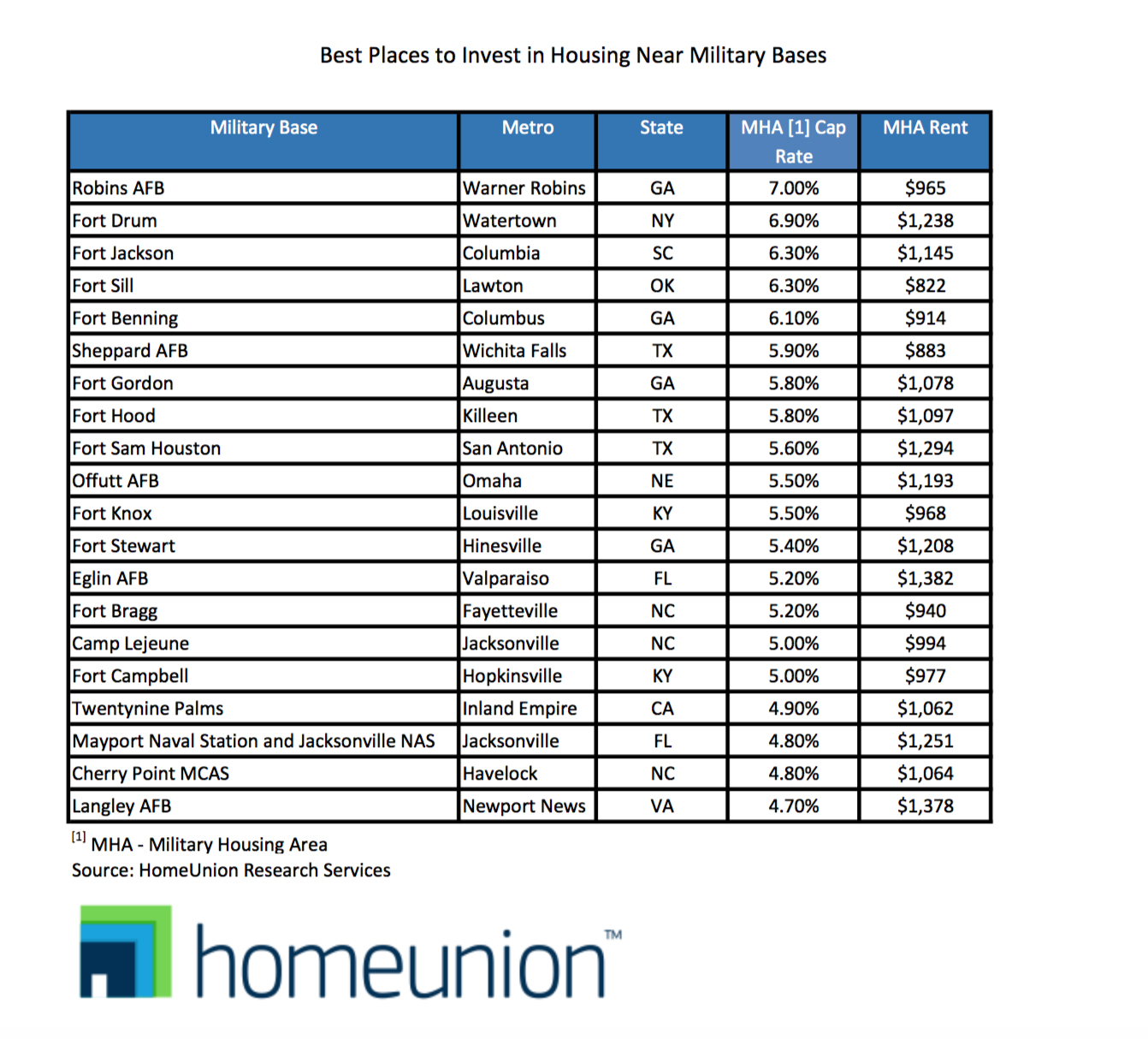
HU_Military_Bases_Chart

New data was released by HomeUnion on the best military towns for investing in single-family rental (SFR) properties based on average cap rates, which are the relationship between an investment property’s net operating income (rents minus expenses) in the first year of ownership and the purchase price of the property. To be included in the list, military bases must have a population of active duty personnel and their families of 15,000 or higher.

SFRs near Warner Robbins, Ga., a U.S. Air Force Base which supports 19,500 active service members and family, have average cap rates of 7 percent. Meanwhile, rental housing in Watertown, N.Y., where the Fort Drum Army base is located, is also an excellent investment with cap rates of 6.9 percent on average. SFRs in Fort Jackson in Columbia, S.C., have average cap rates of 6.3 percent.

“The military bases included in this study are located throughout the United States,” explains Steve Hovland, director of research for HomeUnion. “SFRs near military bases that offer the highest returns, however, are primarily located in the South and Midwest,” he adds. One California base made the list – Twentynine Palms, a Marine Corps branch with 17,700 people in the Inland Empire.

“Acquiring SFRs near military bases may be one of the best real estate investment strategies, for a variety of reasons,” explains Don Ganguly, CEO of HomeUnion.

“For example, military service members are employed by the Federal government, which provides greater employment certainty than the private sector. Demand from service men and women is stable, particularly as the military limits overseas deployments following two protracted wars. In addition, the military compensates service members based on market-rate rents, rank and dependents, giving landlords incentive to lease to military personnel and their families,” he adds.

“The transient nature of serving in the military also means that there is a substantial population of government workers that prefer to rent rather than buy, driving demand over the short and long term,” adds Hovland.

For more information, visit www.homeunion.com.

…read more

From:: Finance and Economy

The Best Military Towns Named for Investing in Rental Homes

By Susanne Dwyer

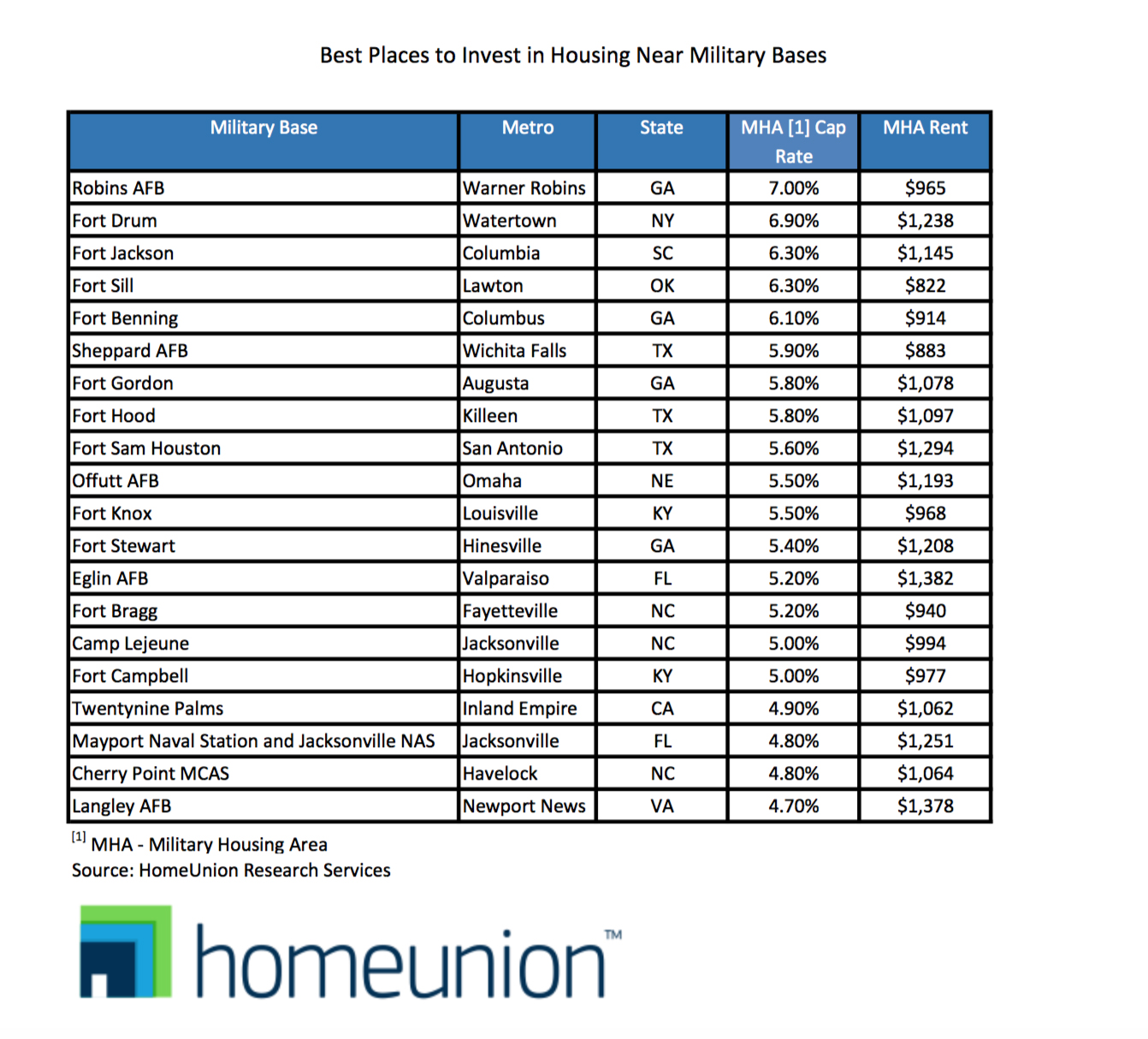
HU_Military_Bases_Chart

New data was released by HomeUnion on the best military towns for investing in single-family rental (SFR) properties based on average cap rates, which are the relationship between an investment property’s net operating income (rents minus expenses) in the first year of ownership and the purchase price of the property. To be included in the list, military bases must have a population of active duty personnel and their families of 15,000 or higher.

SFRs near Warner Robbins, Ga., a U.S. Air Force Base which supports 19,500 active service members and family, have average cap rates of 7 percent. Meanwhile, rental housing in Watertown, N.Y., where the Fort Drum Army base is located, is also an excellent investment with cap rates of 6.9 percent on average. SFRs in Fort Jackson in Columbia, S.C., have average cap rates of 6.3 percent.

“The military bases included in this study are located throughout the United States,” explains Steve Hovland, director of research for HomeUnion. “SFRs near military bases that offer the highest returns, however, are primarily located in the South and Midwest,” he adds. One California base made the list – Twentynine Palms, a Marine Corps branch with 17,700 people in the Inland Empire.

“Acquiring SFRs near military bases may be one of the best real estate investment strategies, for a variety of reasons,” explains Don Ganguly, CEO of HomeUnion.

“For example, military service members are employed by the Federal government, which provides greater employment certainty than the private sector. Demand from service men and women is stable, particularly as the military limits overseas deployments following two protracted wars. In addition, the military compensates service members based on market-rate rents, rank and dependents, giving landlords incentive to lease to military personnel and their families,” he adds.

“The transient nature of serving in the military also means that there is a substantial population of government workers that prefer to rent rather than buy, driving demand over the short and long term,” adds Hovland.

For more information, visit www.homeunion.com.

…read more

From:: Real Estate News

Houston Realtors warned to be on lookout for “foot fetish creep”

Houston-area Realtors and real estate agents, especially female ones, need to be on the lookout for a “foot fetish creep” who’s been targeting local agents, the Houston Association of Realtors warned its members. While the man is on the phone with a female agent, he asks the agent to describe her footwear and will usually request that she take off her shoes for “improved cell phone reception.” …read more

From:: Real Estate Wire