Aerohive Networks shares fall more than 20% on weak outlook

Aerohive Networks Inc. shares dropped in the extended session Thursday after the cloud-networking company forecast an outlook below Wall Street estimates. Aerohive shares fell 21% to $4.45 after hours. The company expects an adjusted third-quarter loss of 6 cents to 7 cents a share, compared with a previous forecast of a loss of 1 cent to 7 cents a share. Analysts surveyed by FactSet had forecast a loss of 4 cents a share. Aerohive also sees an adjusted fourth-quarter loss of 6 cents to 9 cents a share on revenue of $43 million to $45 million. Analysts had estimated break-even bottom-line results on revenue of $50.7 million.

Market Pulse Stories are Rapid-fire, short news bursts on stocks and markets as they move. Visit MarketWatch.com for more information on this news.

…read more

From:: Stock Market News

McDonald’s to book $130 million restructuring charge

McDonald’s Corp. said late Thursday it expects to book about $130 million in pre-tax charges in the third quarter for restructuring efforts. The fast-food franchise said the charges work out to 12 cents a share after taxes. The charges are part of the company’s effort to refranchise about 4,000 restaurants by the end of 2018 in an effort to save about $500 million. McDonald’s, which is expected to report on Oct. 21, is expected to post earnings of $1.49 a share, according to analysts surveyed by FactSet. Shares of McDonald’s rose 0.3% to $115.76 after hours.

Market Pulse Stories are Rapid-fire, short news bursts on stocks and markets as they move. Visit MarketWatch.com for more information on this news.

…read more

From:: Stock Market News

September Brings Slight Yearly Increase in New Home Purchase Mortgage Applications

By Susanne Dwyer

Mortgage applications for new home purchases increased 3 percent this September, relative to September 2015, according to the Mortgage Bankers Association’s Builder Application Survey (BAS) data. Compared to August 2016, applications decreased by 7 percent. This change does not include any adjustment for typical seasonal patterns.

“After a strong start in 2016 and despite evidence of increasing costs, mortgage applications for new homes have maintained a pace modestly above 2015 rates,” says Lynn Fisher, MBA’s Vice President of Research and Economics. “The monthly decline in mortgage applications in September is largely attributable to typical declines in building activity this time of year. That said, builders are facing headwinds from rising labor costs. Looking forward, year over year growth in applications is likely to remain muted for the balance of 2016.”

By product type, conventional loans composed 68.8 percent of loan applications, FHA loans composed 17.5 percent, RHS/USDA loans composed 0.9 percent and VA loans composed 12.7 percent. The average loan size of new homes increased from $325,224 in August to $326,998 in September.

The MBA estimates new single-family home sales were running at a seasonally adjusted annual rate of 593,000 units in September 2016, based on data from the BAS. The new home sales estimate is derived using mortgage application information from the BAS, as well as assumptions regarding market coverage and other factors.

The seasonally adjusted estimate for September is a decrease of 1.3 percent from the August pace of 601,000 units. On an unadjusted basis, the MBA estimates that there were 44,000 new home sales in September 2016, a decrease of 8.3 percent from 48,000 new home sales in August.

MBA’s Builder Application Survey tracks application volume from mortgage subsidiaries of home builders across the country. Utilizing this data, as well as data from other sources, MBA is able to provide an early estimate of new home sales volumes at the national, state, and metro level. This data also provides information regarding the types of loans used by new home buyers. Official new home sales estimates are conducted by the Census Bureau on a monthly basis. In that data, new home sales are recorded at contract signing, which is typically coincident with the mortgage application.

For more information, visit http://www.mba.org.

…read more

From:: Finance and Economy

How Far Does $400,000 Go in the Hottest Investment Markets?

By Susanne Dwyer

homeunion_chart

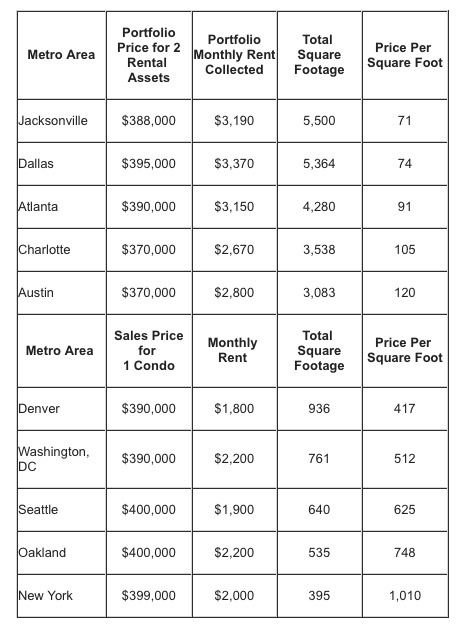
Have you ever wondered how far $400,000 could take you in various markets? This has been analyzed in a newly released HomeUnion report comparing investment property values in 10 of the most sought-after markets among HomeUnion’s clients. The company analyzed what a total of $400,000 will buy a single-family rental (SFR) investor in these popular markets: Jacksonville, Dallas, Atlanta, Charlotte and Austin; versus what a real estate investor can acquire for the same price in the non-HomeUnion markets of Denver, Washington, D.C., Seattle, New York and Oakland, which are frequently coveted by investors.

When using leverage at 25 percent, markets in which HomeUnion operates are more affordable, offer renters and investors significantly more square footage, and provide investors with the ability to earn much higher monthly rental returns.

“Our study confirms that investors’ dollars go much further in the South and one of the biggest metros in Texas than they do in Oakland, New York, Seattle, Washington, D.C., and Denver,” says Steve Hovland, director of research for HomeUnion. “Not only do investors get more for their money; they can buy a larger home or homes in a nicer neighborhood, allowing for the potential to capture higher rental income in the Austin, Charlotte, Atlanta, Jacksonville, and Dallas markets.”

Here’s what a 25 percent down payment on a $400,000 investment will buy in 10 of the most sought-after U.S. housing markets:

For more information, visit http://www.homeunion.com.

…read more

From:: Finance and Economy

Eaton Vance raises quarterly dividend by 6% to 28 cents a share

Asset manager Eaton Vance Corp. said Thursday it is increasing its quarterly dividend by 6% to 28 cents a share. The new dividend will be paid Nov. 15 to shareholders of record as of Oct. 31, the company said in a statement. Shares were down 0.7% Thursday, but are up 15% in the year so far, while the S&P 500 has gained 4.5%.

Market Pulse Stories are Rapid-fire, short news bursts on stocks and markets as they move. Visit MarketWatch.com for more information on this news.

…read more

From:: Stock Market News

Oil ends with a gain as weekly U.S. output falls

Oil futures settled higher Thursday, finding support from a weekly drop in U.S. crude production, despite the first supply climb in six weeks. The Energy Information Administration reported that weekly crude output from the lower 48 states fell 36,000 barrels to 7.969 million barrels a day–the lowest level since June 2014. The EIA also said that crude supplies rose 4.9 million barrels for the week ended Oct. 7. November West Texas Intermediate crude rose 26 cents, or 0.5%, to settle at $50.44 a barrel on the New York Mercantile Exchange.

Market Pulse Stories are Rapid-fire, short news bursts on stocks and markets as they move. Visit MarketWatch.com for more information on this news.

…read more

From:: Stock Market News

Office Depot, OfficeMax to close on Thanksgiving Day

Office Depot Inc. said Thursday that its stores, including those under the OfficeMax brand, will close on Thanksgiving Day. Shoppers can visit the website starting at 12:01 a.m. on Thursday for Black Friday deals, the company said in a statement, and online purchases can be picked up in-store starting Friday, Nov. 25. Office Depot stores will open at 6 a.m. Office Depot shares are down 2.8% in Thursday trading, down 41.5% for the year so far. The S&P 500 Index is up 4.4% for 2016 to date.

Market Pulse Stories are Rapid-fire, short news bursts on stocks and markets as they move. Visit MarketWatch.com for more information on this news.

…read more

From:: Stock Market News

Gold settles 0.3% higher as dollar slips

Gold futures settled higher Thursday, building on gains seen in electronic trading Wednesday following the Federal Reserve’s release of policy meeting minutes, as the dollar slipped. Gold for December delivery settled up $3.80, or 0.3%, at $1,257.60 an ounce, while the U.S. dollar retreated 0.4% against a basket of major currencies. A weaker dollar provides a boost to dollar-denominated commodities. Silver for December delivery , on the other hand, settled down 4.7 cents, or 0.3%, at just under $17.46 an ounce.

Market Pulse Stories are Rapid-fire, short news bursts on stocks and markets as they move. Visit MarketWatch.com for more information on this news.

…read more

From:: Stock Market News

What Do Current Economic Trends Mean for Property Management?

By Marc Courtenay

There are times where we throw caution to the wind and go “all in.” There are other times to pause and carefully ponder the realities of what may be “coming around the bend.” Perhaps, after nearly 8 years of low interest rates and endless economic stimulants, we are now in the “carefully ponder” stage of economic realities. Now is a good time for property managers to be cautious. Notice I didn’t say “scared” and I never propose “indolence” (an excellent word to know about). With patience and keen observations come immediate results. It’s the power of doing almost nothing.

Recently we learned that the U.S. economy added only 151,000 jobs during August, giving the reluctant Fed justification to delay an interest rate hike until December. That’s the most likely scenario. This familiar posture for the Fed was exacerbated by the Chinese economic scare, plunging oil prices and spooked equity markets in early 2016. Then Brexit hit leading into the summer meetings and now the uncertainty of the upcoming U.S. elections.

“Lower-for-longer,” interest rates now look like “lower forever” unless the Federal Open Market Committee (FOMC) surprises and proceeds with normalizing monetary policy. This appears unlikely. Low interest rates benefit borrowers, including single-family rental investors. At today’s rates, investors will be able to leverage investment assets at historically low rates.

Meanwhile auto sales are turning south. After rising for 66 straight months, retail car sales have now fallen four out of the last six months. My sources say that this trend is likely to continue.

This and other factors suggest the making of a new economic trend and not just for the auto sector. The entire economy is beginning to show unmistakable signs of slowing.

When people are overwhelmed with financial uncertainty they buy fewer cars and take fewer vacations. They’re going to eat out less and cut back on noncritical spending and purchases.

In other words, the big drop-off in car sales could mean U.S. consumers are already cutting back. That’s probably why U.S. manufacturing is weakening as we begin the 4th quarter.

Last month, the Institute of Supply Management (ISM) reported that its Purchasing Managers’ Index fell from 52.6 in July to 49.6 in August. This index measures the strength of the U.S. manufacturing sector. When the index dips below 50, it signals recession. More importantly, the services and manufacturing sectors are now weakening at the same time. It’s significant that both indices would weaken so much at the same time.

The manufacturing index dropped to 49.4% from 52.6% in August and the ISM services metric slipped to 51.4% from 55.5%. The combined reading was also the weakest in six years. Look out below!
Here’s my takeaway: Now’s a good time to upgrade and streamline your property management business. Have the best most efficient technology and software available to navigate your operations.

Develop a “wait and see” strategy that takes into consideration the perspectives and preferences of your clients. Take the time to know what they are and invite their feedback now, not later.

Doing “almost nothing” incorporates …read more

From:: Property Management